Sorting Bottles and Packaging
We've entered the sixth month since Romania implemented a Deposit-Return System, and the system administrator, RetuRO, states that from its inauguration on November 30, 2023, until May 15, 2024, people have returned 350 million PETs, bottles, and aluminum cans.
Congratulations, dear Romanians! You've done a great job! Despite the problems you may have encountered at times, from dysfunctional machines and traders refusing to accept bottles, to stores offering shopping vouchers instead of cash.
If you've faced such situations and want to know what you can do, I invite you to read the two articles in the links, because there you will find the interview with one of RetuRO's representatives, whom I specifically asked what tools we have at our disposal.
The Deposit-Return System five months after implementation. Part 1
The Deposit-Return System five months after implementation. Part 2
The good news is that we have shown that Romanians are just as eager to recycle as other Europeans, provided they are given the necessary infrastructure.
The less good news is that there's still a long way to go. The collection rate for beverage packaging did indeed rise to 27% in April, but Romania needs to reach a 65% collection rate for all packaging, including non-beverage packaging, if it wants to meet its commitments to the European Commission. And, of course, if we want to avoid fines, which we, the taxpayers, will ultimately pay.
To increase this collection rate, we have only one chance: to collect and return DRS packaging! We need to set aside, in a bag or a box, mineral water bottles, juice bottles, beer bottles, wine bottles, which have the "Packaging with deposit" symbol on the back, and when the bag is full, go to any store, return them there, and ask for the deposit back, 50 bani for each bottle.
What happens next? With these millions of bottles, after we take them to the store or put them in machines, you might have wondered. Where do they go and when? How many of them have already been recycled? Are they definitely recycled and not just thrown away? This time, I set out to answer these questions. Moreover, to show you, so you can see with your own eyes, because I visited a RetuRO sorting and counting center and filmed the entire process. This is the next step, after the store, the packaging does not go directly to recycling. There is this intermediate, extremely important step, which you can see in the video.
What a RetuRO sorting center looks like
Last year, when RetuRO invited me to Cluj, to the inauguration of the first sorting and counting center for packaging within the Deposit-Return System, I declined the invitation because I would have had to fly there and I thought the carbon footprint wasn't justified. I was still under the influence of the discussion with Ed Gillespie, author and speaker on sustainability topics, who came by train from London to Bucharest for the Climate Change Summit, where eEco was a media partner. So, if it's practiced by bigger players, I don't see why we shouldn't also practice this reluctance to fly too often.
However, at the opening of the Otopeni center, here in Ilfov, half an hour from my home, there was no way I could miss it. Especially since I knew this would be the largest and most advanced regional hub out of all ten RetuRO centers.
I had been to a waste sorting station before, but I also wanted to see what a state-of-the-art, 10,000 square meter DRS sorting center looked like.
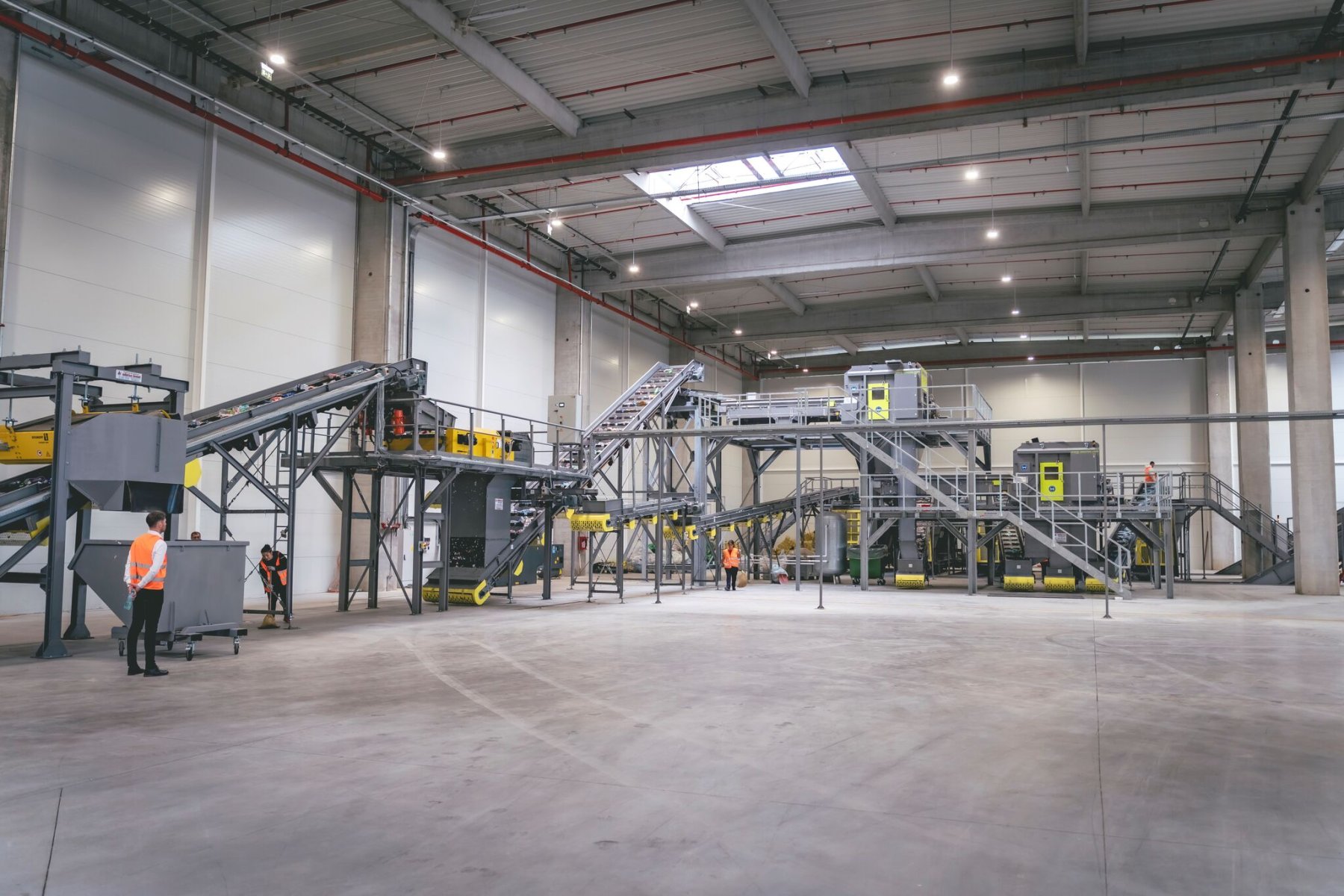
And indeed, I felt like I was abroad. Although there are 150 people working there in three shifts - and thus recycling creates new jobs - the process is quite automated. You can see in the video that people just unload the bags onto the conveyor belt; otherwise, the machines seem to do all the work. They count, separate, sort by category, by color, press the packaging, and bale it. So that it is ready to go for recycling.
How much packaging has been recycled so far
Out of 267 million packages returned by people in five full months of DRS operation, from December 2023 to April 2024, almost half have been recycled. Why haven't all collected packages been recycled yet? Because the procedure isn't that simple. Beyond all the sorting and counting, a significant quantity of PETs, bottles, and aluminum cans (all originating only from beverages, not milk, not tomato juice, etc.) must accumulate before a truck leaves for the recycling plant. And this whole process takes time.
However, there's a chance this time between collection and recycling will be shortened with the opening of this new Otopeni center, because it is more efficient. Sorting and processing are done twice as fast here; the machines can count up to 70,000 packages per hour. But as for recycling, there's no question, all will be recycled, as that's why this system was created.
And since a third of the packages collected nationwide come from the Bucharest-Ilfov area, it was imperative to open a regional center here, in the capital's area. This is the fourth one inaugurated, after those in Bonțida (Cluj county), Giarmata (Timiș county), and Brașov. And in all these four already functional sorting centers, over 2.6 billion packages can be processed annually.
In the next three months, three more centers will be opened, in Bacău, Ploiești, and Dolj. Because, in total, 7 billion packages are placed on the Romanian market annually. And the system must reach a point where it can collect and process this huge quantity of plastic, glass, and aluminum cans.
So, the hard part is just beginning. And RetuRO knows this. Because summer is coming, as I heard Emanuel Pârvulescu, president of the Retailers' Association for the Environment, point out at the launch conference of the Otopeni center. "We have to get through summer at the seaside," he said on stage. Because, after all, in summer, at the seaside, the quantity of water and drinks consumed increases significantly. Thus, implicitly, the quantity of packaging to be recovered also increases.
As we say in Moldova: "The party has just begun!"