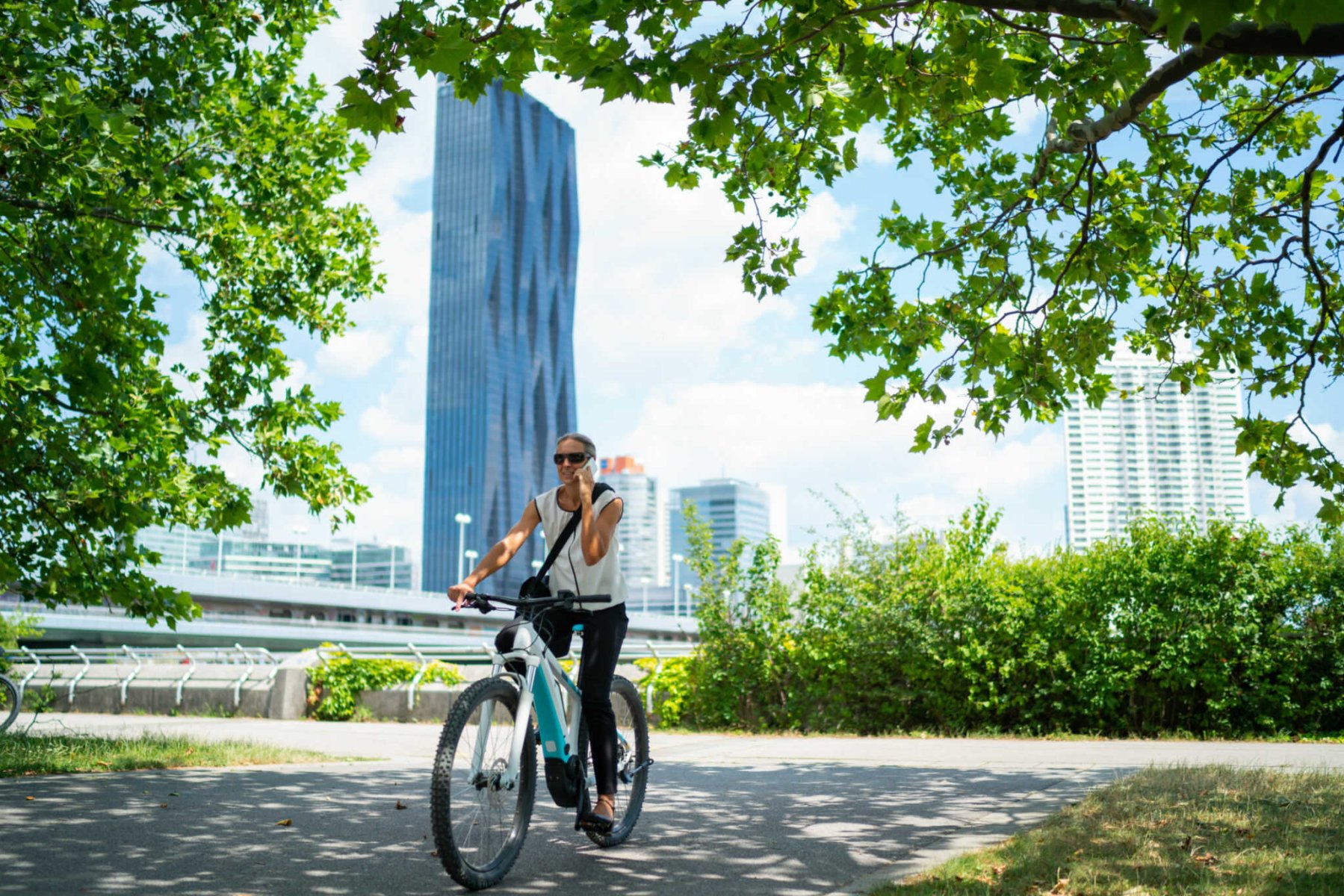

In the north of the capital, in sector 2, there is an office building opened in 2021, with an area of 29,000 square meters.
In Globalworth Square, 2,000 employees from various companies work, having rented the space.
It seems like all the other office buildings in the area, but it has something different. It is one of the most sustainable office buildings in the world.
Although when you enter the building you don't realize it, beneath this building we have a geothermal system that recirculates water coming from great depths, heats it to an optimal temperature, and then transmits it to our circuits.
(Oana Cojocaru, Sustainability Director at Globalworth)
The heat pump is practically a chiller, which also works in reverse mode. Both in heating and cooling mode, providing a significant contribution to the building's climate control systems. This heat pump is connected to the building's geothermal installation and works in tandem with it and with the ice storage, along with the cooling towers, ensuring much-improved efficiency.
Practically, the heat pump is a water-cooled chiller, using extracted water that circulates through the ground, water that is constantly at a temperature of around 10-14 degrees throughout the year, significantly enhancing its efficiency compared to a classic air-cooled chiller, which depends on the external air temperature to achieve optimal performance. (Florin Iosif, PropTech Manager at Globalworth)
Since the building was put into use until now, the geothermal system has managed to provide 31% of the energy consumed. And during transition periods,spring and autumn, the geothermal system together with the heat pump provides 100% of the energy for heating and cooling.
The system is more complex than that. It also has an ice storage component, and practically, one of the building's classic chillers is used at night, when the outside temperature is lower and the electricity tariff is cheaper, to produce ice and store it in those ice storages. The ice is then used during the day to cool the building, and practically, this system has a major advantage because it has the "peak shaving" effect, flattening consumption peaks. (Florin Iosif, PropTech Manager at Globalworth)
Energy optimization is not done manually but with the help of digitalization. There is a control room where all systems are centralized and where software analyzes data in real-time and optimizes all equipment.
This platform takes all raw information from the BMS, uploads it to a cloud, where it performs more advanced analysis and improves it, adds occupancy patterns based on the time of day or day of the week or day of the year, because in summer, people are on vacation and occupancy decreases.
Together with information related to external temperatures and forecasts - the system is connected to the meteorological station near the buildings - compiles all this information, adjusts it, and sends it back to the BMS, which adjusts in real-time the operating setpoints of the main equipment.
That is, the equipment no longer operates based on a static setpoint, set by a predefined program in the BMS, but there is dynamic analysis and dynamic adjustment every 15 minutes. (Florin Iosif, PropTech Manager at Globalworth)
Automation saves between 10-15% of energy consumption.
And it also helps reduce the company's carbon footprint.
We have targets approved by SBTi from 2023 to reduce the carbon footprint at the portfolio level by 46% for Scope 1 and Scope 2.
That is, Scope 1 is what the building produces at the place of operation, Scope 2 is the energy we extract from the grid to heat or cool it.
The targets apply to the year 2019 and we must reach these targets by 2030.
At this moment we can say that by 2025 we have already reached the targets for 2030. (Oana Cojocaru, Sustainability Director at Globalworth)
By 2050, all buildings in Romania must reach zero carbon emissions, according to a European directive.
Because Romania did not transpose the directive into law in time, we are already in infringement proceedings.
A building's footprint is not limited to energy. In a "green" building, water consumption and waste generated by tenants also matter.
100% of the water used daily in toilets in the sector 2 building is recycled water. And 100% of the water used for irrigation is also recovered water.
The building has a greywater recovery system installed. That is, the water used in sinks, for handwashing. Which is treated, chlorinated, and reintroduced, recirculated into the system, to be used in toilet tank reservoirs.
And rainwater is also collected in a tank to be used later for watering the grass around the building.
All these systems were planned from the construction of the building. The newest implementation, in February 2025, is a "waste tracker", aimed at monitoring how much each tenant recycles.
This resulted in the recycling rate increasing from 4% to 16% in one year of operation.
The results are still not what we desire. I think we all want to reach a recycling rate of 70% and hope that in the coming years, through awareness and persistence, we will get there. (Oana Cojocaru, Sustainability Director at Globalworth)
Until everyone recycles, the building managers have managed to reduce their waste costs by 50%, with the help of a compactor.
Garbage is paid by the cubic meter, and the device reduces the volume of household waste by half.
Watch a new video episode from the project Second Life. Circular Economy Models, produced by Sustainable Solutions Association, with support from Stratos.
You can see the other 17 episodes here.