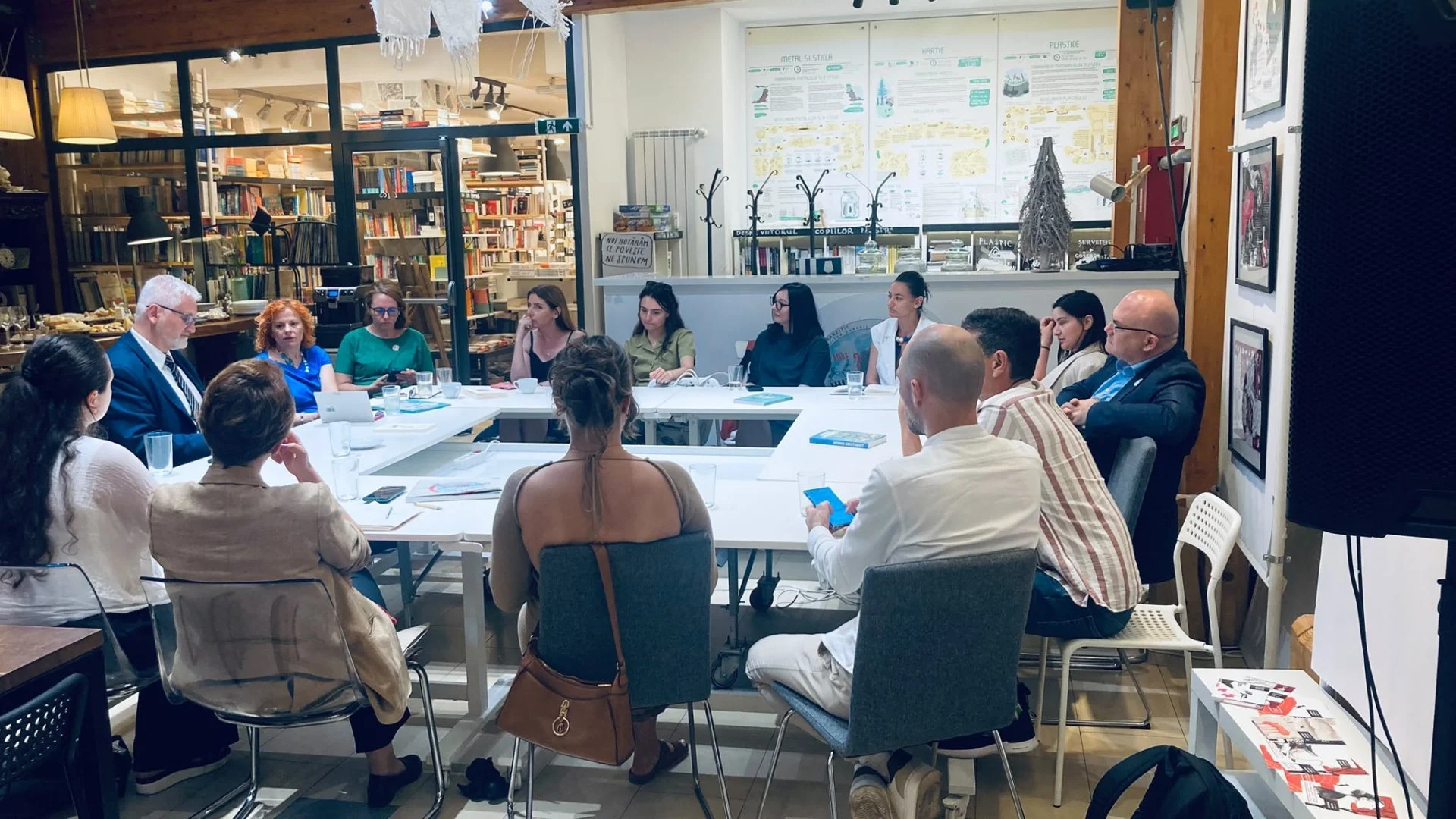
Meeting on Energy Transition
During his recent visit to Romania (June 9-10, 2026), Jan Dusik, Deputy Director of the Climate Directorate of the European Commission, met with several Romanian ambassadors of the European Climate Pact in the context of preparing legislative changes in the energy sector that the European Commission will make to accelerate the transition to renewable sources.
Organized as a debate of ideas among field specialists, the discussion was attended by a significant part of the Romanian community of European Climate Pact ambassadors, who thus had the opportunity to better understand Brussels' perspective and convey their messages to it: Sorin Cheval, Mihail Caradaica, Ana Maria Todoran, Teodora Ghenciu, Emil Zorila, Ioana Petrescu, Laura Petrescu, Laura Soroceanu, Cristina Baltoi, Alexandra Ghenea and Raul Pop (State Secretary at the Ministry of Environment, Waters and Forests, former Pact ambassador). Also, two valuable partners of the pact contributed with opinions to the debate: Ateliere Fără Frontiere and Seneca Anticafe.
Those present analyzed the evolution of how climate change is viewed: it is increasingly evident that climate policies can no longer be approached solely from the perspective of environmental arguments, as climate change affects multiple dimensions of people's lives: health, agriculture, food, water, transport, energy, security, and other elements that make up (or alter) quality of life. Therefore, there is a need for diversification and innovation in communicating the causes and implications of climate change to society. Discussions also covered misinformation on social media, difficulties in communicating certain overly specialized topics, and the risk associated with prioritizing competitiveness over cohesion and social justice.
Concrete aspects were reviewed, from the capacity to generate energy at the individual and local level (in the perspective of achieving energy security) to the gradual elimination of fossil fuel subsidies.
The conclusions emphasized how important it is for public investments to be aligned with long-term climate objectives and for society to find resources to seek and encourage the use of resilient alternatives.
The European Climate Pact is a framework for climate awareness and action for European citizens, with the perspective of transforming the European Union into a modern, competitive, and resource-efficient economy, where:
- we reach net-zero greenhouse gas emissions by 2050;
- economic growth is decoupled from resource use;
- no person and no place are left behind.
The European Climate Pact Secretariat is coordinated at the European level by the Directorate-General for Climate of the European Commission and coordinated in Romania by REPER21. The activities of the European Climate Pact are communicated in Romania by DC Communication.
Additional details: ro@euclimatepact.eu