Photo Gallery
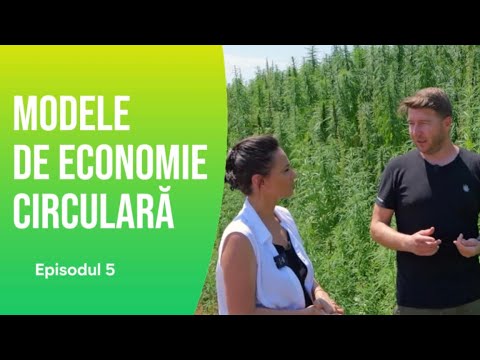
In Vințu de Jos, Alba County, a Dutch company cultivates industrial hemp. The company started planting in 2012, initially on a trial basis, ten hectares. They saw that the soil was good and continued to expand, reaching 350 hectares in 2024. The same company processes what it cultivates and would have the capacity to process hemp from others, from 4,000 hectares. But it can't find enough. In Romania, at most 1,000 hectares are still cultivated, compared to 45,000 hectares before the Revolution.
The difference between industrial hemp and marijuana
Farmers have come to avoid this crop due to confusion with the drug Cannabis, which over time has led to a lot of bureaucracy and fear of the police. Daniel Stanciu, head of the HempFlax farm in Alba, explains the differences between the two crops:
"They belong to the same family, but they are two totally different plants. It contains THC - THC is the drug in the plant - but it has a very, very, very low content. It cannot be used for consumption at all. In our country, the THC content is regulated at 0.2%. The varieties we use have a content of 0.01%.
Marijuana is usually cultivated more indoors than outdoors, because it needs a different kind of light. It cannot withstand exaggerated temperatures, as industrial hemp can. Marijuana leaves are much more rounded than industrial hemp leaves, which are long and narrow. Marijuana leaves are much wider. It has a smell, you can feel a taste of hemp, but it has absolutely no psychotropic effect, as marijuana does. It's like smoking dry grass."
Hemp contributes to the European Green Deal
The Dutch knew, 12 years ago, that hemp was a wonder plant. It is very resistant and does not require much maintenance. It doesn't grow weeds or diseases, so it doesn't need chemicals. It doesn't need too much water and most importantly, it absorbs carbon dioxide and stores it in the soil. A single hectare of hemp absorbs up to 15 tons of CO2. Just like a young forest, but in only five months.
For all these reasons, industrial hemp is a strategic crop in the vision of the European Union. Firstly, because it contributes to achieving the objectives of the European Green Deal. But also because it has numerous uses. After harvesting, all parts of the plant are used.
The stem or fiber, for example, is used in the textile industry, the automotive industry, and construction, where it replaces mineral wool, rock wool, and polystyrene.
The wood from inside the fiber is used as animal bedding or for building ecological houses. By combining hemp wood, which farmers call shives, with lime and water, the so-called "ecological concrete" or Hemcrete is produced.
And the dust resulting from processing is also valorized, becoming compost. Nothing is thrown away.
Sustainable agriculture
Hemp is also very suitable in crop rotation systems, imposed on farmers who want to continue receiving subsidies.
"Starting this year, we are obliged by both the Agency for Payments and Intervention and the Ministry of Agriculture to no longer practice monoculture. So, somehow, every two or maybe three years, you are obliged to change. And hemp is an excellent preceding plant. It can be used, even if, let's say, a farmer's main crop is corn." (Daniel Stanciu - HempFlax farm manager)
However, beyond the multiple uses and benefits of hemp, the farm in Alba is an example of good practice in terms of how it conducts agriculture. Because climate change has also affected them, and production has decreased and costs have increased, two years ago they began the transition from intensive agriculture to "No-till" agriculture, where the land is no longer plowed. And the positive effects are already visible.
All of these—no-till farming, crop rotation, and converting biomass into compost—represent sustainable agricultural practices. For these, small farms under 10 hectares have financial support available. Find out how much money is involved in the video report. A new episode of the campaign "A Second Life. Circular Economy Models," initiated by Sustainable Solutions Association, with the support of Stratos and Eco Synergy, aiming to inspire the business environment to transition from a linear to a circular business model as quickly and easily as possible.
Here you can watch episode 1 about Waste: From Waste to Raw Material, Through Innovation
Here you can see episode 2, dedicated to Construction: Profit from Rubble
Here, episode 3, dedicated to Packaging: Goodbye Single-Use Packaging
And here, episode 4, dedicated to the Textile Industry: Better Designed, Less Discarded Clothes