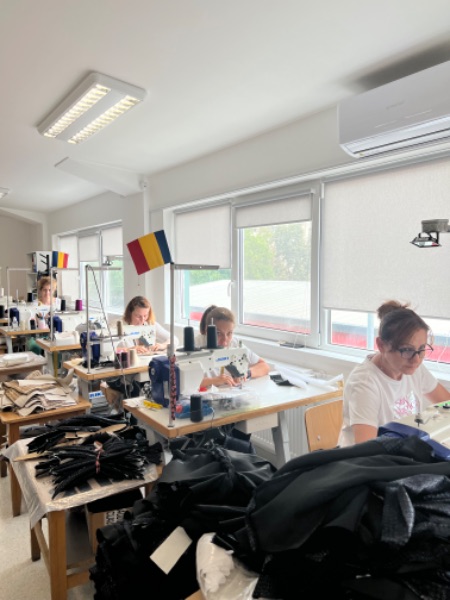

Responsible Sewing Workshop
A textile factory in Focșani, which has been producing clothes for major international brands for 30 years and has seen over time the mistakes of famous fashion houses that lead to overproduction, overconsumption, and a lot of textile waste, decided in 2019 to try to do things differently. More responsibly. So in 2019, it launched its own Romanian brand, named EMAT. What does this brand do differently?
Limited Series Production
Anca Țurcanu, the general manager of the company, says the biggest NO is not to produce too much. How does she succeed?
She explains:
"We target only fabrics that are not available in very large quantities. If a fabric of 700 meters is available, we don't take it. It's too much. Because you risk creating unsellable products from it. And you end up with a stock of finished products that eventually turn into waste."
Dead Stock
Then, instead of buying new materials, 90% of the fabrics used for the local brand come from leftover stocks from major brands.
"An international brand always produces its fabric to create a certain collection. But it will always order a surplus of fabric. And at the end of the production period, there may be 80 meters of fabric left. They can't do anything with it, they can't create a new model. Because it doesn't fit with the marketing story, to include it in a new collection. It effectively remains stuck in the warehouse for years. And some of them have even set up platforms with international access. Where they place these material remnants, dead stock, which new brands can then purchase," says Anca Țurcanu.
Clothing Patterns
Also, to generate less waste, the clothing factory focuses heavily on the design phase of the garments. Because, they say, if the pattern is not correctly constructed, you end up butchering a fabric that cannot be subsequently produced. What does this mean? If you've already cut a shirt, let's say, and the pieces are not correctly cut, you will no longer be able to produce that shirt, and the entire amount of fabric becomes waste.
The pattern also has several stages. After someone checks that each piece is correctly constructed, the pieces are then arranged on a computer simulation of the large fabric, so that as little unconsumed, wasted space remains as possible. A kind of puzzle.
The result is printed on a large sheet. Only then does the actual cutting begin. The small scraps that remain after cutting are also transformed into something: a book cover, a collar, sleeping mask, or hair elastic. Anything, just so they don't become waste.
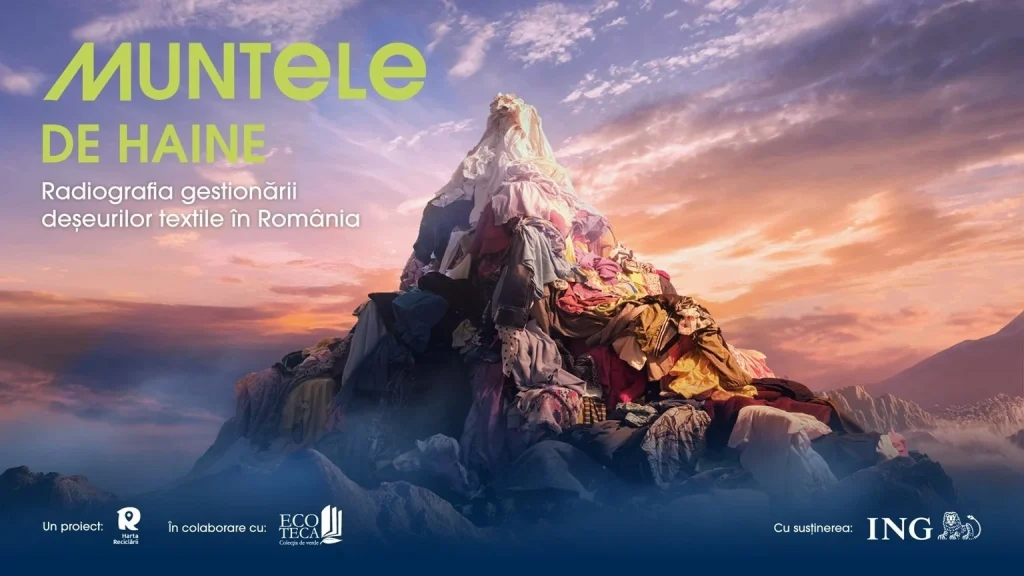
Why so much effort? Because the textile industry has gotten out of control. Almost 10% of annual greenhouse gas emissions are due to the textile industry. And 35% of microplastic pollution in the oceans is caused by the textile industry.
Luminița Roșca, general manager of Stratos, an environmental consultancy company, explains:
"We've reached a situation where very little is collected. 22% of what is generated is collected, 1% is recycled. These are global figures, I assume it's no different in Romania. Not to mention that we might be doing even worse."
Why Clothes Aren't Recycled in Romania
By January 1, 2025, producers and waste holders in Romania are required to separately collect textiles, according to OUG 92/2021. However, those working in the field are skeptical that this law will be enforced, as there are few places to recycle textiles from the population in Romania.
One of the largest textile recyclers, MINET, located in Râmnicu Vâlcea, does not accept, for example, waste from the clothing industry, much less directly from people. It receives from the automotive or furniture industry, but not from the clothing industry, even though that's where most textile waste is produced. Why? Because they are hard to recycle and hard to capitalize on. There is not yet a market for recycled textile fibers. Why is it hard to recycle, Cezar Bulacu, director of research and development at MINET, tells us:
"For example, the mix of colors and the mix of fiber concentration. There is no material 100% wool, 100% acrylic, 100% polyester, or 100% elastane. They are mixes and of poor quality, but they also don't have a fibrous benefit, the result is weaker than in the more technical industry, where fibers are of better quality, are the same color and structure, have the same properties."
Thus, over 46,000 tons of textile waste end up annually in Romania being incinerated or in landfills. And it's unknown how many end up in fields.
To change this, the Association for Sustainable Solutions, with the support of Stratos and Eco Synergy, created this video report. To show, concretely, how the transition from a linear economy to a circular economy can be made and to inspire others.
The report is part of the campaign "A Second Life. Circular Economy Models" and is episode number 4, dedicated to the Textile sector.
Here you can watch episode 1 about Waste: From Waste to Raw Material, through Innovation
Here you can see episode 2, dedicated to Construction: Profit from Rubble
And here, episode 3, dedicated to Packaging: Goodbye Single-Use Packaging.