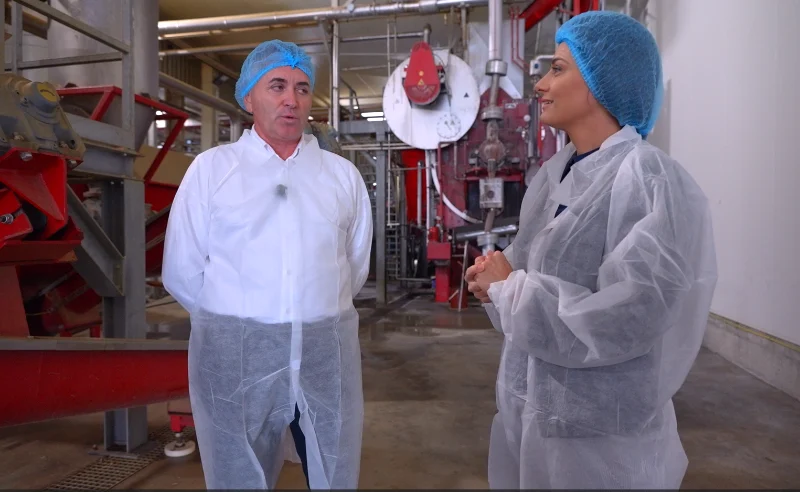
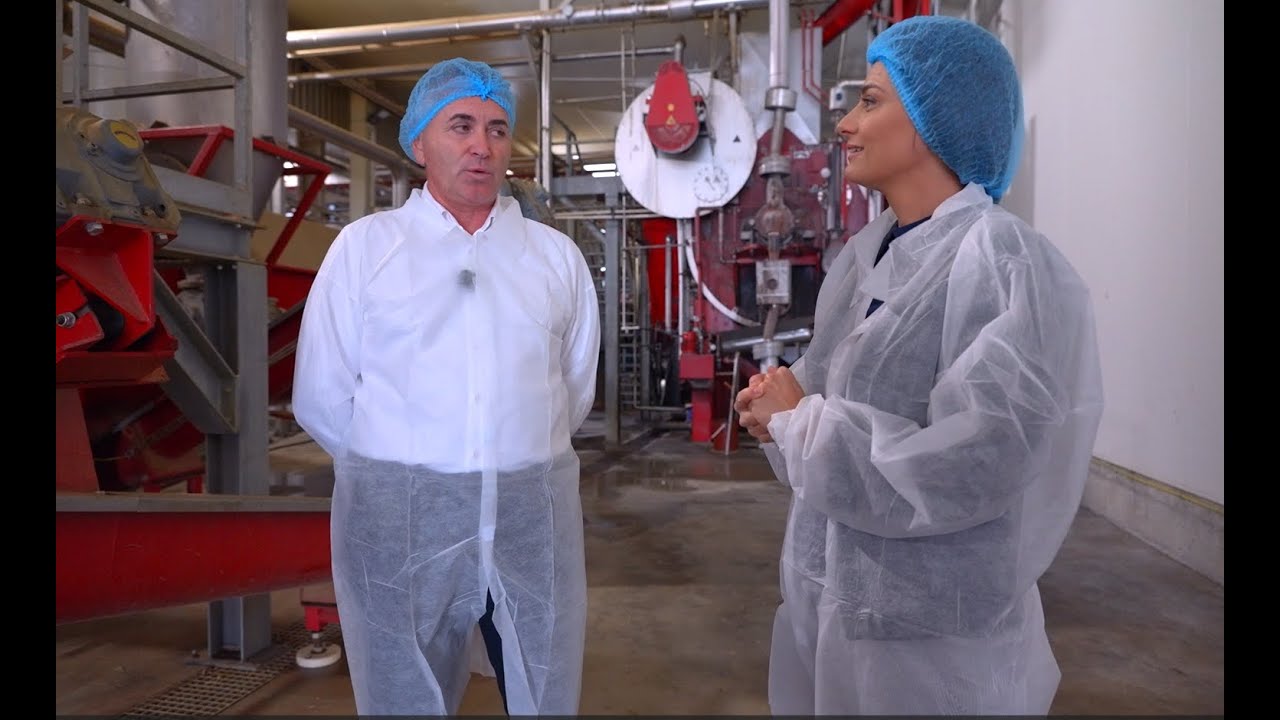
Conversation at Transavia Facility
One of the largest poultry producers in Romania, Transavia, which produces 120,000 tons per year, owns three slaughterhouses. The largest of them is located in Oiejdea, Alba County. To capitalize on the waste from the slaughterhouses, the company also established a protein meal factory.
Everything that is not edible from the bird, such as feathers or viscera, is collected separately and transformed into four products:
-
- feather meal
meat meal
blood meal
poultry fat
Every day the factory processes 150 tons of leftovers, from which it obtains 30-40 tons of protein meals and fats. All are sold abroad. The meal is bought by companies that produce animal feed, and the fat by companies that make biodiesel. Thus, the company earns money from a waste for which it would otherwise have had to pay.
Toader Popa, Director of Industrialization Division at Transavia: "You can send it for neutralization, but I won't tell you what the destruction costs are. Once you consume resources, we're talking about energy, electricity, gas, and so on... and you don't recover anything. You just have an expense, which is enormous. By doing this, we not only recover all our energy costs, but we also add value, and the business is much more sustainable and healthier in every way, because we control the entire link in the process and have always been concerned about this aspect."
The protein meal factory is just one of the strategies that support the company's "Zero Waste" policy. The company tries to reuse everything that can be reused not only from the slaughterhouses but also from all 31 poultry farms it has established in over 30 years of activity.
Diana Pavel, the company's environmental director, says that any waste resulting from an upstream activity is treated in a downstream activity, still within the company. And in this way 99% of waste is valorized.
How? We asked.
"If the raw material, resulting from the vegetable farms, is used within the combined feed factory, the by-products, as I like to call them and not waste, are further used as raw materials in the main poultry farming activity. And here I refer to vegetable residues, to straw, which are used as bedding for raising birds.
If from the activity of the combined feed factory we have a raw material that goes to the poultry farms, we also have a secondary material. These are the vegetable residues, seed husks, which we also give to be used in agriculture, either for animal husbandry or in agriculture." (Diana Pavel, Environmental Director at Transavia).
Manure transformed into a resource
To control the entire value chain, in 2011 the company also established vegetable farms, in addition to poultry farms. It purchased 10,000 hectares of land in Aiton, Cluj County, where it cultivates sunflower, corn, and wheat for bird feed. And the manure from the poultry farms becomes organic fertilizer.
The company thus obtains this organic fertilizer for free from its own poultry farms, which helps it use up to 70% less chemical fertilizer. Which it would otherwise have had to pay for.
Adrian Farcaș, Director of the Vegetable Sector at Transavia:
"On the land where we started the agrochemical study, from 2011 until now, and started using natural fertilizer, we noticed a production increase of over 40% compared to classic fertilizer.
And financially it's an advantage, because recently the trend of chemical fertilizers has been on the rise. It's a challenge today to buy chemical fertilizer, considering that we no longer have any factory in Romania that produces chemical fertilizer. Most chemical fertilizer comes from export."
The only disadvantage of this type of fertilizer is the smell, says Adrian Farcaș. But it lasts at most 2-3 days and is only in the area where it is spread.
Sludge used as fertilizer
For the company, the advantages are much greater. Expanding into agriculture has helped it capitalize on another waste it produces in large quantities: sludge from its six own wastewater treatment plants. Starting in 2021, the sludge is also used as organic fertilizer on cereal-cultivated lands.
Many of these circular economy measures have been voluntarily implemented, primarily for economic advantage: cost efficiency, resource efficiency, and reducing dependence on external suppliers.
However, some measures could become mandatory for all large agri-food companies with the implementation of the European "Farm to Fork" strategy. Launched in 2020, the strategy sets clear targets for reducing pesticides, fertilizers, and waste in the food sector, responsible for 26% of greenhouse gas emissions at the EU level.
Discover how a company can become more competitive through such circular economy measures in episode 14 of the campaign "Second Life. Circular Economy Models", produced by Asociația Soluții Sustenabile with the help of the environmental consultancy company Stratos. A project initiated to speed up Romania's green transition by providing examples of good practice from the business environment.
You can watch the other 13 episodes here.