Kaufland Zero Waste Catalog
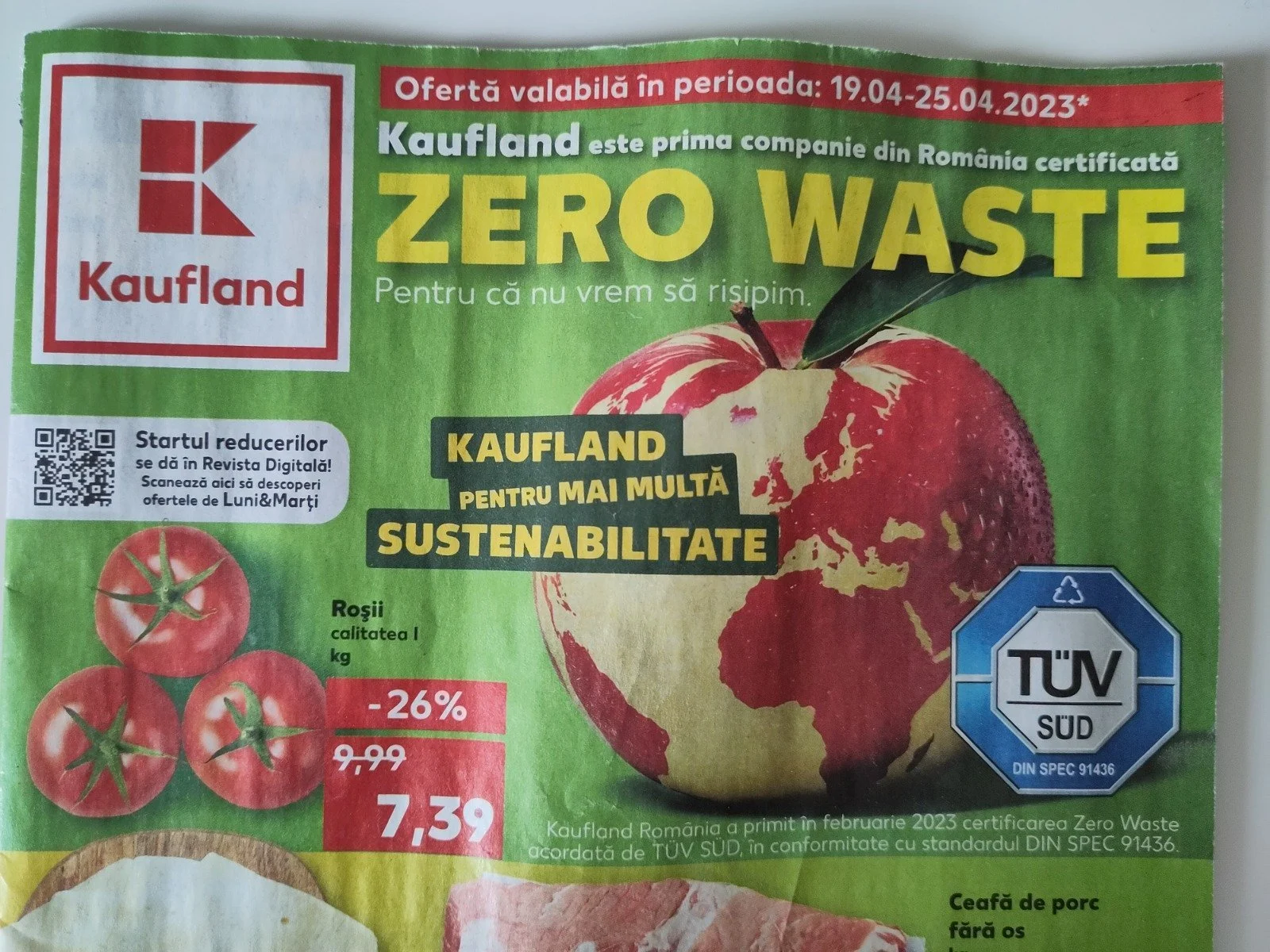
The news that the most profitable retailer in Romania had been Zero Waste certified hit me a week ago. On the Climatic Circle page, a picture appeared with the front page of the catalog from April 19-25. For those concerned about sustainability, it's clear that the title is a blatant case of greenwashing and a legitimate reason for outrage.
But this catalog probably reaches hundreds of thousands of people. People who may not have the luxury of wasting time and energy to critically analyze and understand how deceptive advertising works, let alone react to it. I immediately decided I needed to find out what it was all about and how Kaufland supports such a claim.
What Kaufland says in its own catalog
It was Good Friday. I was supposed to meet a friend from my hometown, so I suggested we take a walk to Kaufland. I asked for the catalog with the zero waste certification at the information desk, and the kind lady there pulled it out from under the counter, from a parcel of future catalogs. On the cover, it states grandly:
Kaufland is the first company in Romania certified ZERO WASTE because we don't want to waste. Kaufland for more sustainability TÜV SÜD, DIN SPEC 91436 On the front cover, we get a few more details about the so-called Zero Waste certification:
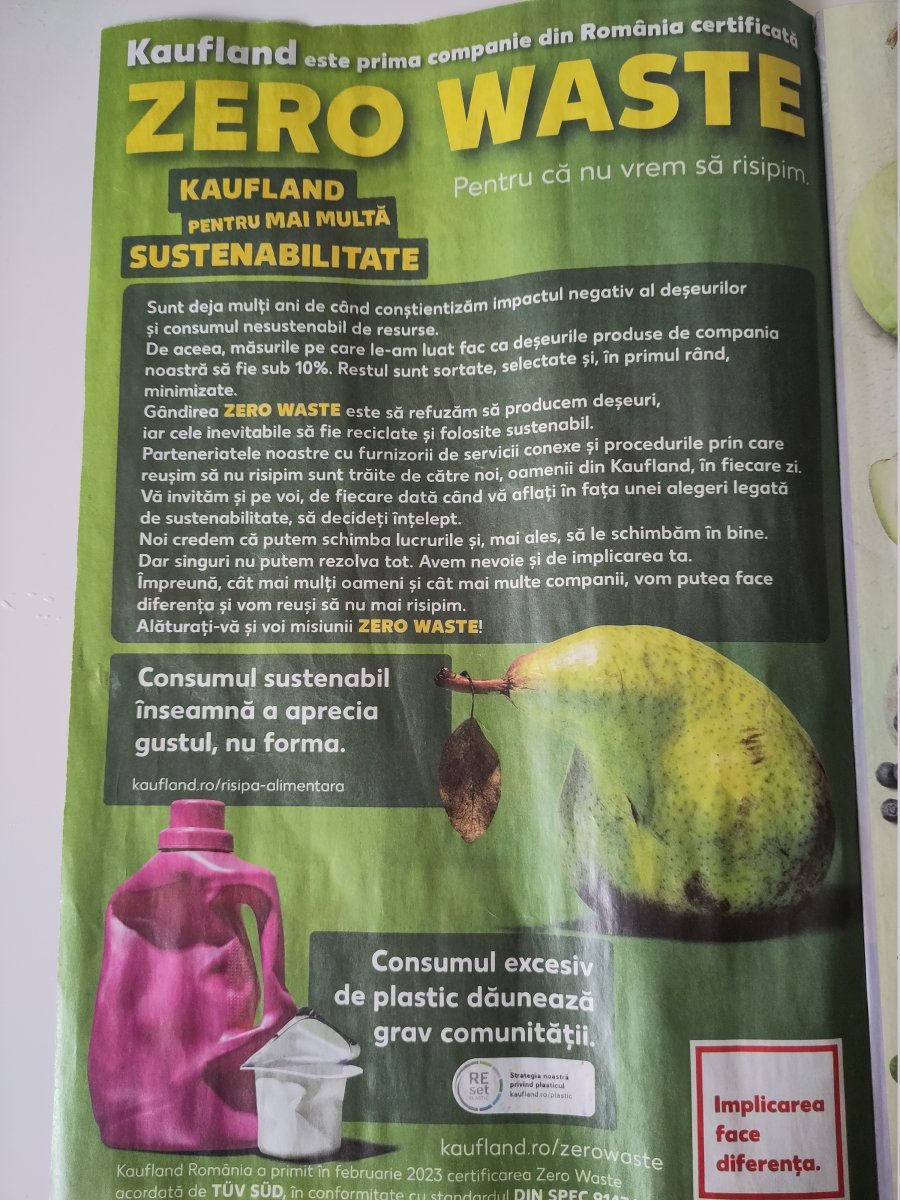
Among other things, we learn from this page that: The measures we have taken mean that the waste produced by our company is below 10%. The rest is sorted, selected, and, first and foremost, minimized. 10% of what? What did the author mean? Perhaps that RESIDUAL waste, the waste that goes to landfill, represents only 10% of the total waste generated? And the remaining 90% are, isn't that right, "sorted, selected, and minimized." Just prevented and sorted, or also RECYCLED? The text continues, somewhat ambiguously, without specifying whether the retailer checks how much of the collected and sorted waste is actually recycled: The ZERO WASTE philosophy is to refuse to produce waste, and that inevitable waste should be recycled and used sustainably. Nowhere are we told by how much waste has been reduced and how much of the separately collected waste is actually recycled. What is certain is that recyclable waste is also waste, that's why it's called waste. Therefore, it would have been essential that the word "residual" appear next to the word "waste" in their statement. It would have sounded something like this: "The measures we have taken mean that the residual waste produced by our company..."
What waste is Kaufland actually talking about
And now we get to the core. A crucial piece of information is missing from the catalog. The fact that the waste Kaufland mentions up and down is actually operational waste. That is, strictly waste generated during its own operations, not packaging waste or food and non-food waste generated along the supply chain, at the consumer's home.
Theoretically, one might think that extended producer responsibility (EPR) for such waste belongs to the manufacturer, not the retailer. But let's not forget that the retailer in question has its own private label products and places an impressive volume of packaging on the market. It therefore has the responsibility to meet recycling targets for the packaging of those products. As a producer, Kaufland could choose to use reusable packaging or to give consumers the option to buy more private label products in bulk. It could also apply the strategy to bulk products in the store that are still packaged in plastic or bioplastic (dispenser drinks, bulk section foods, etc.) As an importer and retailer, it could ask or require suppliers to change their packaging methods where possible (for example, for organic fruits hyper-packaged in plastic, which have no other utility than to differentiate them from non-organic products).
But all of this would mean losing money. Far more money than what was poured into a marketing campaign in which it alarmingly self-proclaims to be "the first company in Romania certified ZERO WASTE." At best, it could have claimed something like: "the first company in Romania certified almost zero waste at an operational level."
The information about operations appears, but only in the press release. A press release that only journalists will consult, not all the people who receive the product catalog or land on the dedicated page on the website. In the press release, the company mentions: Kaufland Romania receives Zero Waste certification from TÜV SÜD Management Service GmbH, in accordance with DIN SPEC 91436, a new reference model for the management of operational waste and recyclable materials. Also from the press release, we learn that: The certification indicates that at least 90% of all operational waste has been prevented, reused, recycled, composted, or fermented. I must mention that I breathed a little easier reading that incineration is not included in the methods for valorizing the 90% of recyclable waste generated. At least that much, if truly transparent communication was not intended for the catalog. But enough with the text analysis. Let's move on to verifying the standard and the certifier.
What about the Zero Waste certification issued by TÜV SÜD
From the press release, we learn that: TÜV SÜD Management Service is a company with over 150 years of experience, specializing in auditing, evaluating, validating, and certifying management systems, especially quality, environmental, health, and safety management systems at the workplace, within manufacturing companies and service providers in all industrial sectors. [...] Through certification in accordance with DIN SPEC 91436, TÜV SÜD offers a new reference model for waste and recyclable materials management for companies in the private sector, public institutions, cities and communities, associations, and non-governmental organizations. Sounds trustworthy, doesn't it? Let's see. I go to this company's website, look for the standard, and, to my surprise, I can download it quite easily, even from here. From the very first pages, I learn that this standard was actually developed by a consortium, which includes TÜV SÜD. But also:
- Circular City — Zirkuläre Stadt e.V. (Circular Berlin), Laura Grotenrath
- DEKRA Assurance Services GmbH, Dipl. Wirt.-Ing. Peter Paul Ruschin
- DEKRA Certification GmbH, Andreas Biermann
- PreZero Stiftung & Co. KG, Marcus Bocklisch, Lukas Held, Carolin Landesvatter
- TU Dresden — Institute of Waste Management and Circular Economy, Prof. Dr. habil. Christina Dornack
- Repaq — Superseven GmbH, Dipl.-Des. (FH) Hannes Füting
- Resourcify GmbH, Felix Heinricy
- TÜV SÜD Management Service GmbH, Julia Bulling, Dipl.-Ing. (FH) Sabine Nessi
A simple search for TÜV SÜD zero waste leads us to a press release from 2022. From this, we learn that: Initiated by PreZero, the standard was developed last year by a consortium of representatives from NGOs, science, business and industry. TÜV SÜD Management Service GmbH was also a partner in this consortium. So, the standard was initiated by PreZero, and TÜV SÜD Management Service GmbH is just a partner in the consortium. Then, why highlight only this company, because it has a reputation in the market? What is hidden? Who is PreZero? We can easily find out on the website, in the company history section:
In 2009, the Schwarz Group, which includes Lidl and Kaufland, established a subsidiary called GreenCycle to manage Lidl's waste. Between 2012 and 2014, GreenCycle also took over Kaufland's waste management. In 2018, GreenCycle changed its name to PreZero. In 2020, PreZero became a foundation and partnered with WWF. In 2021, Kaufland and Lidl stores sold products made from materials recycled by PreZero. In 2022, PreZero created a consortium that included TÜV SÜD, to certify Lidl stores in the Czech Republic with a zero waste standard. In 2023, Kaufland Romania announced it was the first company certified zero waste in Romania by TÜV SÜD, without specifying in the catalog that it only refers to its own operations and forgetting to mention PreZero.
Kaufland asks others to join the initiative
Besides omitting this essential information, Kaufland Romania has the courage (or perhaps incompetence?) to run an entire campaign around its "achievement." It posts a video bragging about the certification and urging consumers to join.
https://www.facebook.com/plugins/video.php?height=314&href=https%3A%2F%2Fwww.facebook.com%2Fkaufland.romania%2Fvideos%2F115834511460122%2F&show_text=false&width=560&t=0 Towards the end of the video, we hear the protagonist say: But we can't solve everything alone. We also need your involvement. This strategy is well-known. Coca-Cola also practiced it successfully: to place responsibility on the consumer. Similarly, Kaufland tells us: we've done our job, now it's your turn. Yours, including consumers and other retailers, whom they also tag in posts. At least something good should come out of this misinformation: that others feel obliged to seek zero waste certifications, to do so with independent certifiers, and to communicate transparently.
What circular economy experts in Romania say
I wanted to know what two waste management experts in Romania thought about the zero waste certification and the associated marketing campaign. These are Elena Rastei, coordinator of Zero Waste Romania, part of Zero Waste Europe, and Raul Pop, former Secretary of State in the Ministry of Environment and circular economy consultant. Elena Rastei is quite reserved in her statements: I am pleased that the certification is not of the "zero waste to landfill" type, which would have accepted the incineration of waste. I cannot comment at this time on the zero waste standard used, as I have not analyzed it. When I contacted him on this topic, Raul Pop was conducting training for journalists specifically on the circular economy. However, he made time to answer me: First of all, I am glad that a private company has voluntarily made the effort to go through a Zero Waste certification process. I am convinced that the learning effort required for this exercise is perhaps more important than the certification itself. And the statement "first company" encourages me to hope that others will follow. Regarding the certification itself, personally, I find it very challenging given the ENORMOUS volume of consumer goods that pass through the company's assets. I hope that the respective certification also has a third-party audit, to certify the quality of the process and data. First of all, I would check whether the data used to substantiate the certification covers all relevant activities (and material volumes). Yes, I also would have liked to learn more about how they were certified. It is possible that the certification is indeed based on concrete data, but I would have liked to verify how relevant this data is for the retailer's overall impact. That's why I wrote to them.
Communication Director too busy to give me an interview
I sent an initial email requesting a video interview on Monday. I wanted to learn more directly from Valer Hancaș, Corporate Affairs&Communication Director at Kaufland Romania & Moldova. They initially ignored me. I sent a reminder on Wednesday, to which they only replied that they had received the email. I insisted on getting an answer as to whether or not they would give me the interview. I called both the press office and directly Loredana Samoilă, Public Relations and Communications Specialist.
They didn't answer my calls, and today I received a refusal by email: the communication director "will not be available in the coming period." They sent me the press release and invited me to send my questions by email. I have already sent them and will announce when and if I receive any response. Until then, the press release is being picked up indiscriminately by the Romanian media, without further checks or questioning the veracity of the misleading statement.
I am leaving here a list of questions that I don't expect to receive answers to. If you have any other questions to add, please send them to me by email at irinabreniuc@gmail.com. I will forward them to the company, again without hope of a response, just like in the past.
- The certification was granted based on the analysis of operational waste from 12 stores, one logistics center, and the head office. How many of the more than 150 stores in Romania will implement the mentioned measures and achieve the performance of a maximum of 10% residual waste sent to landfill, and when?
- Where does the remaining 10% of residual waste go? What quantities are we talking about?
- How has the absolute quantity of waste sent to landfill evolved over the last 10 years? Has it increased or decreased, in absolute values and relative to sales?
- Regarding avoided waste: by what % has Kaufland reduced the amount of waste generated as a result of the implemented measures?
- Regarding separately collected and sorted waste: Into how many fractions is it collected in stores and how do you ensure that employees actually comply?
- Recyclable waste, collected and sorted, is not necessarily ultimately recycled. What happens to this recyclable waste from Kaufland's operations in Romania? Where does it go?
- What % of collected and sorted waste actually gets recycled, given that there is a degree of contamination that sometimes makes recycling practically impossible?
- For packaging waste, economic operators are obliged to ensure the recycling of 65% of the packaging placed on the market. To what extent has Kaufland fulfilled this obligation in the last 10 years?
- A firm position regarding waste incineration is not mentioned anywhere. Does Kaufland Romania send waste for incineration or co-incineration in cement factories, through its partners?
- We only learn from the press release that it is exclusively about a near-zero waste certification obtained for its own operations. Why did you choose to communicate misleadingly in the catalog, on the website, and in commercials, where you do not mention that it refers to operational waste?
- The creation of the standard you refer to was initiated by PreZero, and TÜV SÜD Management Service GmbH is only a partner in the consortium. Why did you hide this and the fact that PreZero, before becoming a foundation, was a former subsidiary of the Schwarz Group, which also includes Kaufland and Lidl?