Photo
Electric cars will be mandatory starting in 2035 in the European Union. After this date, new gasoline and diesel cars will no longer be sold. But that doesn't mean internal combustion cars will disappear, because until then they will continue to be sold. And so they will continue to pollute.
The automotive industry is undergoing the greatest transformation in history since the invention of the internal combustion engine. And it must adapt to new rules, innovate, recycle, transform its business model to bring cars with the lowest possible carbon footprint to the market. Even before being obligated to manufacture and sell only electric cars.
BMW has accepted the challenge of discussing the circular economy measures it has already implemented, which already show measurable results and make the cars put on the market less polluting by reducing the carbon footprint from the production phase.
What a "circular car" looks like
The biggest environmental impact in producing a gasoline or diesel car comes from the vehicle's main components: steel, aluminum, and plastic. And the BMW group states that 80% of the aluminum used for car bodies is recycled aluminum, while new aluminum is processed with green energy. This is the most significant change made by the car manufacturer to reduce its carbon footprint because this circular economy measure alone reduces carbon dioxide emissions by up to two tons, which is approximately 10% of the entire car's footprint over its entire lifecycle. In one fell swoop.
In the production of an electric car, things get more complicated. The biggest environmental impact comes from batteries. Mainly due to the metals used: lithium, cobalt, nickel, manganese, graphite, copper. The solution found here by BMW is the recovery and reuse of materials.
Alexandru Șeremet, BMW Romania communication manager: "One of the materials that is very well recovered and reused now is nickel for batteries. And by using recycled nickel in a large electric car, about 0.6 tons of carbon dioxide are saved. And if I add green energy in the production of battery cells, I get to about 2 tons."
Battery recycling is still a global challenge. Investments of 9 billion euros in the EU are needed to expand capacities by 2035. However, the car itself can be recycled up to 95%.
"However, it is not enough that it can be recycled; you also need to optimize it for recycling. There is that design-to-recycle principle that is becoming increasingly present in the way cars are prepared, developed, and built. An example is the design of seats. The goal there is not to use too many combined materials. That is, not to use very complex sewn combinations of leather and fabric. To use a single material, so that I don't spend a lot of energy and resources on how I recover and recycle the seat," says Alexandru Șeremet.
Reuse increases profit
In factories where even 1,500 cars are produced daily, one of the main challenges is the availability of materials. Not only for car components but also for production machinery. The solution, in this case, is also reuse.
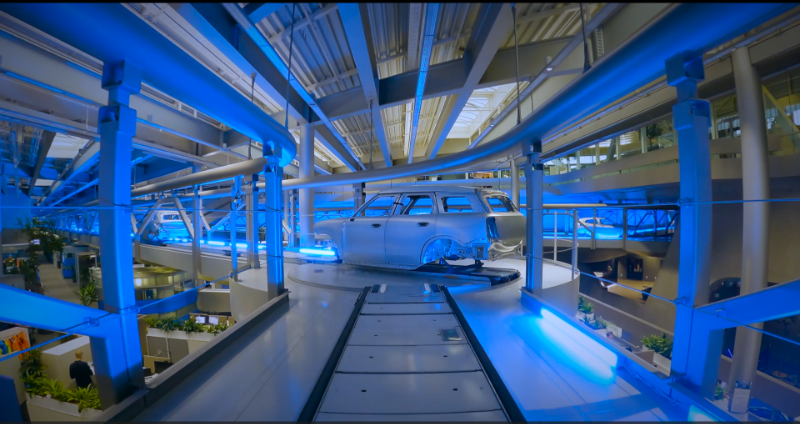
However, in addition to the materials from which the machinery is made, the machinery itself can also be reused. Over 90% of the production work of a car is done by robots. And reusing robots also reduces costs. In the case of BMW, by up to 40 million euros.
"It's a continuous effort because it's not a switch; you click a button, and suddenly you abide by circular economy principles, and the problems are solved. It's very easy to talk about saving solutions, it's very easy to talk about being green, being clean, but it's a very complicated puzzle. We're talking about ultra-complex products.
There are thousands of components that go into a car from thousands of suppliers. Once the car is on the street, I have to think about how to power it, and it's no longer enough to look at the car as a standalone entity; I have to look at it in an ecosystem, in the macro-energy ecosystem, how energy is produced, how it's distributed, how hydrogen is produced, how fuel for the internal combustion engine is produced. This path to zero-emission mobility does not depend only on the car manufacturer; it depends on the entire ecosystem around the manufacturer. From how raw materials are extracted to how the energy that goes into the battery or reserve is supplied," concludes Șeremet.
What other circular economy measures can be taken in the complex automotive industry, as well as unique images from BMW factories around the world and vintage photos from decades ago, with Elvis Presley behind the wheel of a BMW car, can be seen in the last episode of 2024 of the "Second Life. Circular Economy Models" campaign.
The campaign is initiated by Asociația Soluții Sustenabile, with the support of Stratos and Eco Synergy, with the aim of inspiring the business community to transition from a linear to a circular business model as quickly and easily as possible.
Here you can watch episode 1, about Waste: From Waste to Raw Material, Through Innovation
Here you can see episode 2, dedicated to Construction: Profit from Debris
Here, episode 3, dedicated to Packaging: Goodbye Single-Use Packaging
Here, episode 4, dedicated to the Textile Industry: Better Designed Clothes, Less Discarded
Here, episode 5, about Sustainable Agriculture: Hemp, a Strategic Crop
Here, episode 6, about Electrical and Electronic Equipment: The New Eco Design
Here, episode 7, about Wastewater: Gold from Sewage
And here, episode 8, about Food Waste: Food Saved from Waste.