Dairy Packaging and Its Issues
After visiting a waste sorting station in 2022, I understood the magnitude of the problem with dairy products packaged in white and beige opaque containers. This type of plastic is not recycled in Romania. Or it is very difficult to recycle. Few facilities accept it. This means that all those milk and yogurt bottles, cartons, and small containers end up being incinerated. Instead of becoming raw material for other plastic products, if not for the same type of container.
As far as I know, the issue has been brought to the attention of dairy producers, and it's relatively easy to solve; it just requires the will to change. From that white plastic that no recycler wants to a transparent, easily recyclable PET.
So, when I saw Napolact's new packaging, I almost jumped for joy because it seemed the change had been embraced. In Romania, where we're used to saying that nothing changes. Or it changes too slowly. Or... you can fill in the blanks.
This dairy producer understood the problem and finally switched to transparent PET.
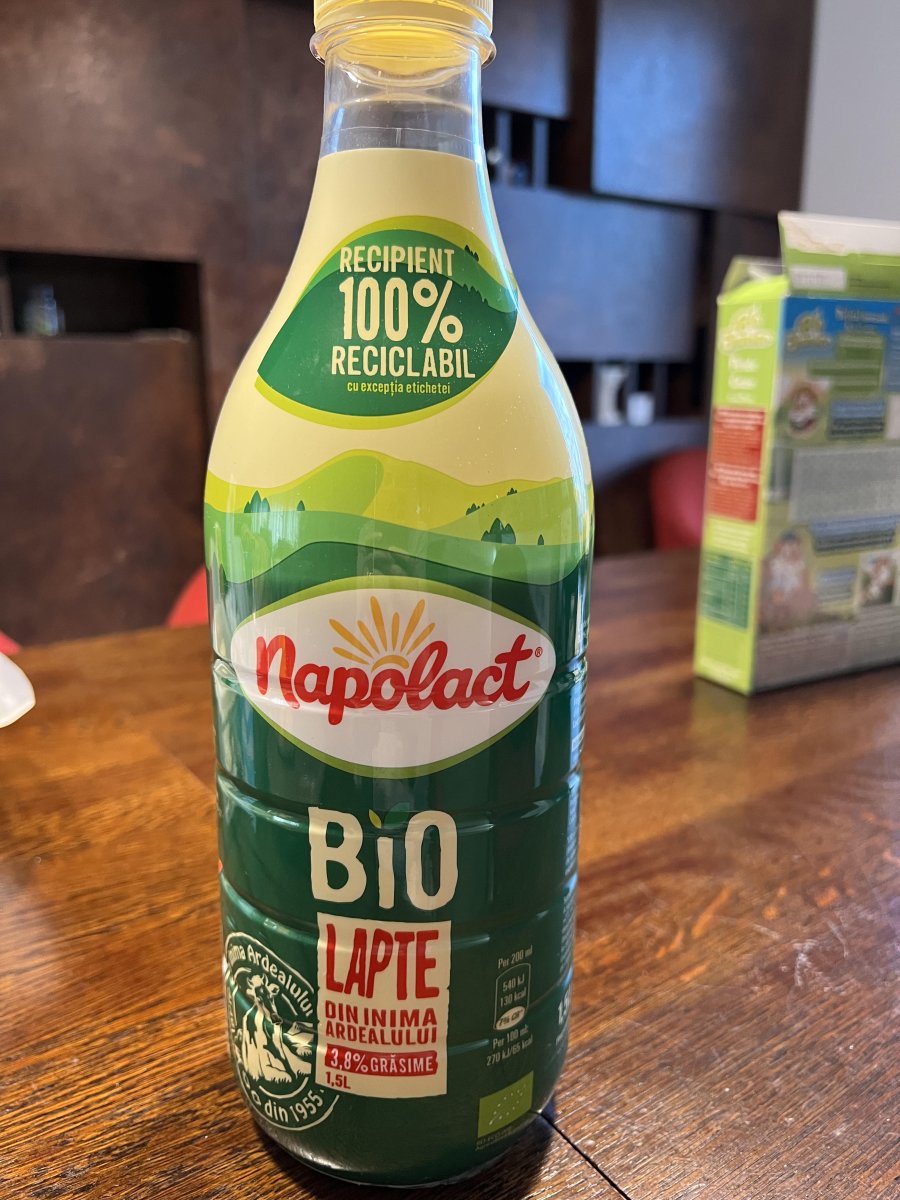
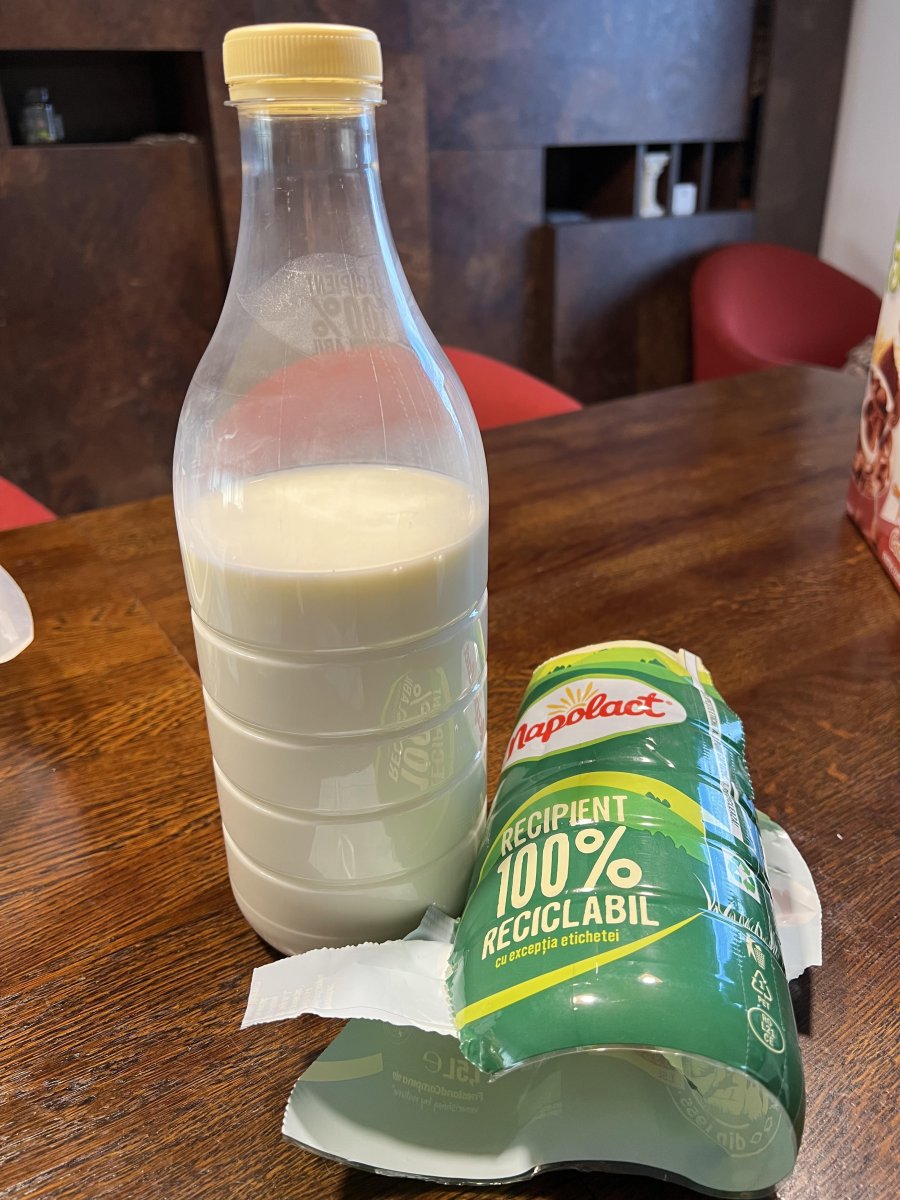
Or not...? I then carefully read what was written on the bottle: "100% recyclable container. Except for the label." And I started asking myself questions:
- How many people will be as interested as I am to read the label? And especially to peel it off?
What happens to bottles whose labels haven't been peeled off? Will anyone at the sorting stations know that beneath that label is a transparent white PET and it deserves to be put with recyclable PETs and not incinerated? Will any sorter bother to remove the label if the consumer hasn't already done it at home? Won't we actually end up in the same situation, where this packaging will still be incinerated, not recycled?
Doesn't this change transfer the responsibility of recycling back to the consumer? Based on the principle "I've done my part, I've changed the container, it's your job to read the label, peel it off, and make sure the PET is recycled"?
Since they made a packaging change, they devised an entire communication campaign on the subject, meaning there was an effort in product design, creation, communication, etc., why wasn't the label also considered? To be recyclable too?
The cap. It's made of HDPE, which is indeed a recyclable material. And we are advised to leave it attached to the bottle. But this means it will be PET + HDPE, a mix of materials. However, the new direction in recycling and the circular economy is to design product packaging, from the start, as much as possible, with the same type of material. Why are we doing something new in 2024 without considering all international recommendations?
When they reached the communication part of the new packaging, didn't "except for the label" bother anyone? That is, to claim, in black and white, that you know a part of your NEW packaging cannot be recycled, but you don't care. That's also an admission, but consumers need a different kind of admission from producers. Namely, that they want to solve the problems they themselves cause, not just pretend to be interested.
I don't even want to delve into the analysis of the communication campaign for this new type of packaging right now. Which has enough elements to be accused of greenwashing.
This time, I want to keep the discussion focused on the packaging problem. And on environmental problems that are only half-solved. Because it's a pattern I see very frequently among large companies. Where there are resources to bring in external consultants if you see that internal people don't fully understand the complex concepts related to sustainability. But it seems that this option is not even considered. Perhaps also because the bosses themselves don't fully understand the concept?
What the experts say
So, we remain with the packaging problem and ask for the opinion of waste management specialists. From whom I wanted to know if this new type of packaging solves the problem of recycling non-transparent white packaging.
Here's what Dan Ceaușescu, CEO of Greenpoint Management, told me: "Yes, in terms of material, transparent PET is the most recycled type of PET. However, in this case, due to the label covering almost the entire bottle, for it to be sorted into the appropriate category in sorting stations (either manual or automatic), the consumer must remove the label before putting the container in the dedicated container/bag. Otherwise, the PET will not be sorted and will still end up being incinerated."
So, something that could have been good and laudable turns, once again, into something criticizeable. A measure that should have been taken to solve the recycling problem may not significantly change the situation. And it seems to be a measure taken just to check a box that something was done. "I did my part, but from now on, others should do theirs." Others, meaning ordinary people, consumers.
Of course, on the other hand, Napolact can say: "But what about the others who haven't even done that much? Why aren't you saying anything about them? Wouldn't it have been better if we hadn't done anything either, and no one would have criticized us?"
The others are Covalact, Gusturi Românesți, Zuzu, Danone, almost all major producers on the market, who haven't even made this minimal effort to replace non-recyclable white containers with a simple transparent PET.
Indeed, taking responsibility and the courage to transform also involve this risk of being scrutinized more than others. But only if the commitment is only halfway. And only if you stop working before it's finished.
Otherwise, you can be cited as a positive example. And I am the first to want to highlight such examples. That's why the emphasis on this platform is on solutions. Sustainable solutions for people and companies. I want to discover and highlight them. To promote them. But while looking for them, I also come across these examples of semi-solutions.
Sustainability and product greening start with design. With eco-design. And perhaps this example actually shows us the lack of sustainability specialists in companies. Marketing, product, communication people suddenly have to do things differently. But there are so many ways to help these people understand the new path. Which neither takes forever nor costs a fortune, so the argument of lack of knowledge cannot be used for too long. You just have to want to.
There are always solutions
The good news is that nothing is permanent. Changes can still be made. Things can still be rectified. And it doesn't have to be a huge consumption of resources for that.
Dan Ceaușescu: "As an improvement, it is recommended to have a smaller label, so that in the sorting process, it is immediately identified as transparent PET, without the need for manual label removal.
The best option is a glass bottle, returnable. Next are mono-material packages, in the case of PET bottles, transparent ones, with the label printed directly on the bottle (engraved - see the Sprite bottle in the UK or with environmentally friendly inks) and with a cap also made of PET."
Does it cost too much to make a narrower label so that the transparent PET underneath is visible and at least correctly classified during sorting, even if the consumer doesn't remove the label? Like water and juice bottles, where we don't have to peel anything off?
Does it cost more than a serious information campaign that you would have to run for your consumers to understand that they need to peel off the label, and more importantly, to somehow motivate them to make this effort? How much time and how many resources would you have to invest in that? And especially, with what results?
For me, the answer seems simple, even without having the budgets in front of me. My hope, however, is that someone who has access to the spreadsheets with figures will be curious enough to do such a calculation. And then, will also have the desire to convince a boss to approve the change. For real. All the way.