Wine Bottles with Corks
The Guarantee-Return System (GRS) barely came into force on November 30, 2023, and already there are attempts to change it. And not in the direction of introducing more types of packaging, aside from beverages, but rather to remove even more packaging from the system.
How so?
On February 20, 2024, the most important parliamentary committees on packaging in the Chamber of Deputies, which must formulate an opinion on the merits of the issue—namely, the environmental committee and the industry committee—approved an amendment that removes wines from the list of beverages included in the GRS.
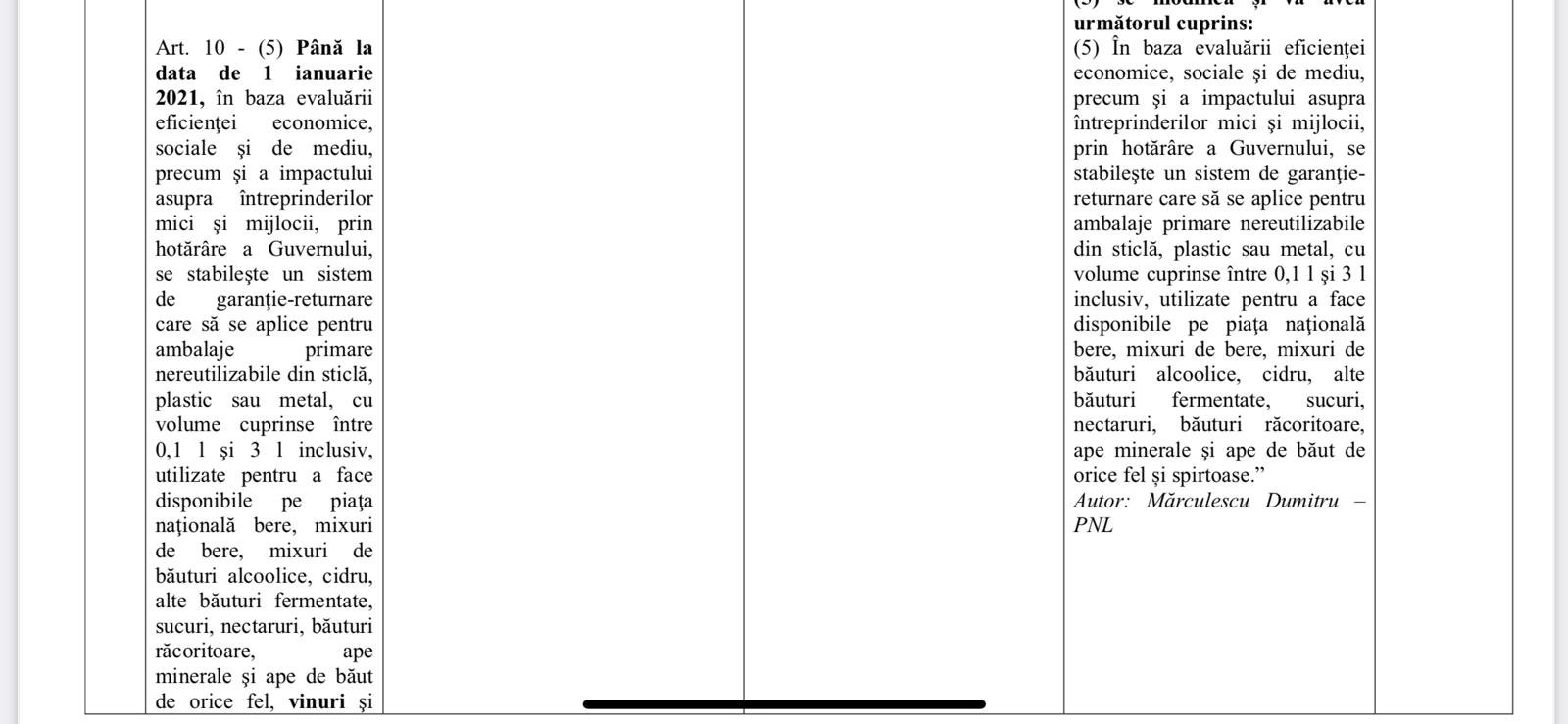
Essentially, from the original article, which read like this:
Article 10 - (5) By January 1, 2021, based on the evaluation of economic, social, and environmental efficiency, as well as the impact on small and medium-sized enterprises, a government decision shall establish a guarantee-return system applicable to non-reusable primary packaging made of glass, plastic, or metal, with volumes between 0.1 l and 3 l inclusive, used to make available on the national market beer, beer mixes, alcoholic beverage mixes, cider, other fermented beverages, juices, nectars, soft drinks, mineral waters and drinking waters of any kind, wines and spirits."
The word "wines" was removed. An attempt was also made to remove spirits, but that proposal failed to pass. However, regarding wines, everyone agreed to remove them from the system.
Why?
This is a question that should be answered, in turn, by:
- PNL Deputy from Mehedinți, Dumitru Mărculescu, a member of the Industry and Services Committee, who proposed the amendment.
- All deputies from both committees who unanimously voted for the amendment.
- The President of the Environmental Committee who approved the amendment, Virgil Popescu, PNL Deputy from Mehedinți.
- The Vice-President of the Industry Committee who approved the amendment, Ilie Toma, PSD Deputy from Hunedoara.
The removal of wine bottles raises questions, especially since, according to the latest warning report published by the European Commission in June 2023, Romania risks missing its recycling targets for total packaging waste, specifically 65% by 2025. We only managed to recycle 39.9% of the packaging placed on the market.
The main purpose of the GRS is precisely this: to help the state achieve mandatory recycling targets for plastic, aluminum, and glass.
Theoretically, we are doing well in terms of glass. According to official data (controversial for many market connoisseurs, who accuse them of being inflated, but we won't discuss that now), out of 460 thousand tons of bottles and jars placed on the market in 2022, we managed to recycle 65%, compared to the 70% target we must reach by December 2025.
But even so... Does this justify removing wines from the scheme, just a few months after the program's launch? When the main criticism was that only beverages were included, and not other types of packaging? And when the main recommendation and expectation was for the program to gradually include more and more packaging, not remove items from it?
Who stands to gain
Until the deputies clarify their official justification (because we might never know the real one), we can't help but notice that the main beneficiaries of such a change are, of course:
- Wine producers – who would spend less to meet their recycling targets if they stay within the old system, OIREP (Organizations Implementing Extended Producer Responsibility)
- OIREPs that handle bottle recovery on behalf of wine producers – who would continue to receive money for this service from the producers.
Accordingly, behind a single word, this time "wines," lie large sums of money. Tens of millions of lei per year. Money that, from the moment wine bottles entered the GRS, was lost by the companies that help producers meet their mandatory recycling targets.
And you don't need to conduct some major investigation to find out, for example, that there's an OIREP that has the most contracts with the biggest players in the wine market. And that this OIREP has as shareholders the son of Adrian Videanu and the wife/girlfriend of Remus Truică, both with serious criminal issues in the areas of abuse of office, illicit gains, embezzlement, undermining the national economy, influence peddling, money laundering, and forming an organized criminal group.
Officials' reactions
The Minister of Environment seems to oppose this change, as he declared yesterday after the government meeting:
Mircea Fechet: "It seems some actors have gotten tired. And they want to escape the Recycling Dance. And there are a few isolated cases of producers who want to leave the dance and hinder what we are building, namely a 'country of recycling.' They resort to various instruments... They have different initiatives in Parliament, trying to obtain exemptions from recycling.
My message remains just as clear and firm: Recycling is not a subject that can be treated superficially.
Therefore, we will unequivocally reject any attempt to withdraw from the Guarantee-Return System.
Nobody should leave the GRS. There is no ecological argument for wine to exit the GRS while beer remains, or for wine to exit while still water and soft drinks remain. As minister, I will oppose such endeavors."
Of course, it would be ideal if the minister could convince his party colleagues and coalition members to also oppose it. Because the ball is now in Parliament, not with the Government. The controversial amendment will be put to a vote in the plenary session of the Chamber of Deputies, and the Chamber of Deputies is the decision-making body for this law.