Sustainability Meets Profitability 2024 Conference
On March 20, 2024, La French Tech Bucharest, a non-governmental organization aiming to connect France and Romania, including through organizing events, gathered several hundred people under the umbrella of an event called Sustainability Meets Profitability.
The organization's president, Gregoire Vigroux, a serial entrepreneur with a strong reputation in the Romanian business market, opened the event, which was its second edition on this topic: Where sustainability meets profitability.
Tudor Popp, founding partner of Hotspot, a company that has been building coworking spaces since 2020, answered the conference's theme very clearly from the outset: "For us, sustainability means quality. And quality means sustainability. Sustainability and profitability work hand in hand, and we are living proof of that."
Benjamin Turquin, Country Manager at BRD Asigurări de Viață, added: "There is no profitability if there is no sustainability."
At the same time, there is no sustainability without investments. Very large ones, according to 69% of companies, as per a study conducted by CSRMedia. But, it seems, largely justified by the benefits brought to the company.
Customer Power
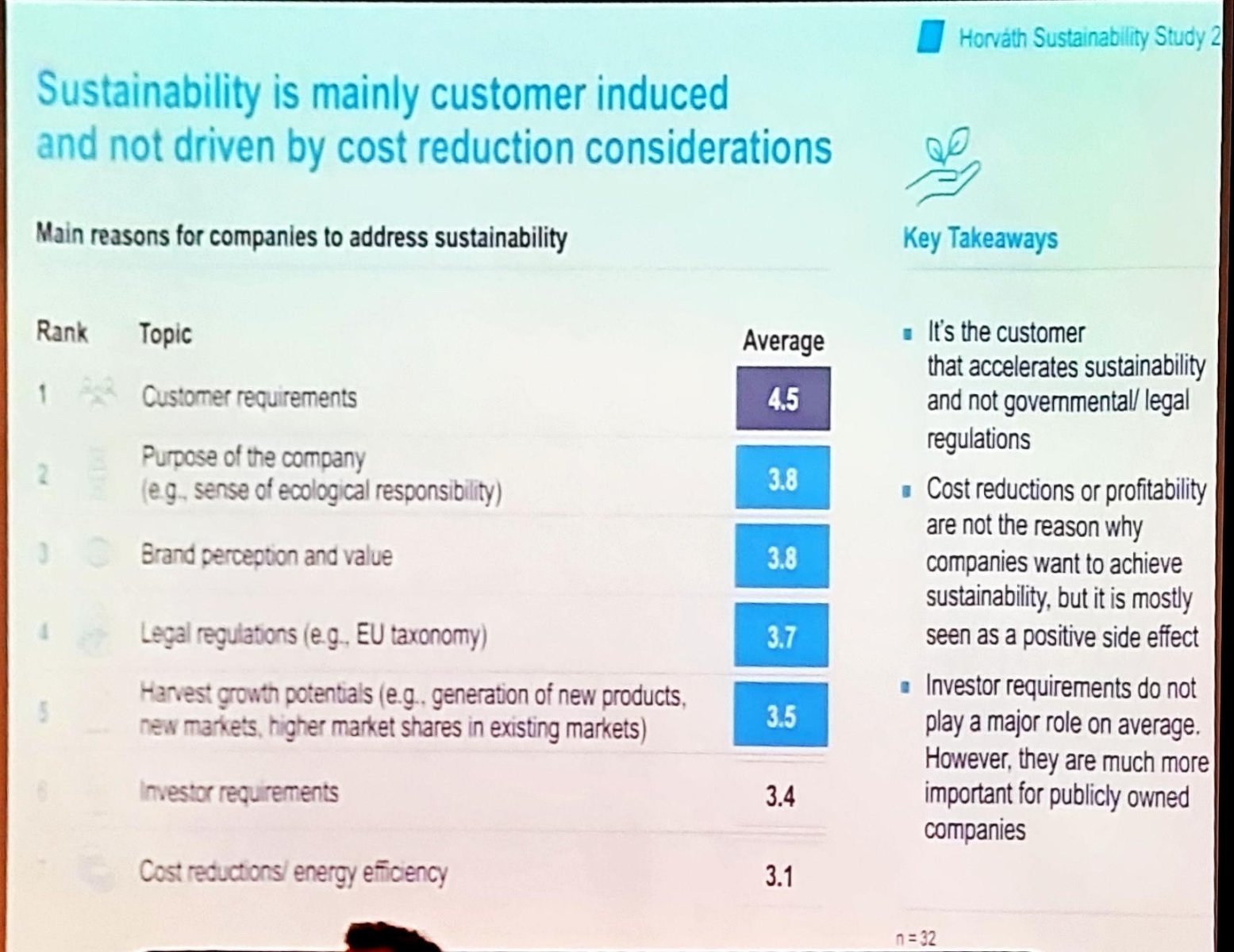
The interesting part is just beginning, because these benefits do not translate into money. Or at least, not yet. Or not enough to be the main reason why companies adopt sustainable practices. As presented by Costin Tira, senior project manager at the consulting firm Horvath.
Neither money, nor laws, nor investors are at the top of the arguments for change. Instead, it's the pressure exerted by customers. Where customers can, of course, be individuals or legal entities.
This was then confirmed by Alex Skouras, director at Alesonor Real Estate Development, the developer of Amber Forest. Compared to previous years, when the main reasons why people bought a certain home were price, location, finishes, and so on, in recent years the main reasons why people choose to buy homes from this developer are:
- Community
Sustainability
And of course, in the top three reasons why companies begin the transition are brand and reputation. Which makes me happy. It means that companies have started to understand the danger they face, with all the regulations related to greenwashing and green labels, if they do not comply with these new directives.
The danger of their reputation being affected, which ultimately translates into costs. The Volkswagen "Dieselgate" scandal is famous, in which the car company cheated on emissions tests, and that cost it over 30 billion dollars.
Conclusions
I left this conference with two important ideas:
- Even if the transition is expensive, and direct monetary benefits are seen more in the medium and long term, there is money for transformation. This assurance was given by Flavia Popa, Secretary General of BRD Groupe Societe Generale, a bank eager to finance as many green projects as possible.
Those who don't offer money, offer support to those who want to innovate. As conveyed by Boualem Saidi, the regional head of the Bayer group, the behemoth that invented aspirin more than 125 years ago.
So, there is money in the market. There are resources. There is no reason to postpone the transition to sustainability any longer. Because, as Ștefan Iulius Budulan, sales manager at Up, frankly put it at the event's opening,