Photo Gallery
After an intense election year in 2024, which added to all the fatigue and tension accumulated since COVID, 2025 shows us a change in Romanians' behavior, including regarding responsible consumption. A change for the worse.
If in 2024 the segment of so-called "ethical" consumers reached a peak of 43%, this year the percentage drops by 11%.
What do ethical consumers mean? These are people who buy products with an ecological label, avoid brands that indirectly use children for labor, consumers who do something daily for the environment, from recycling to avoiding food waste or using public transport instead of their personal car.
In 2025, only 38% of consumers declare that they still have such habits, compared to 43% last year.
Why the number of sustainable Romanians has decreased
Corina Cimpoca, founder of MKOR, the research company that conducted the study "The Ethical Consumer in Romania," looks at the context of the last five years to explain the downward trend in responsible consumption in Romania.
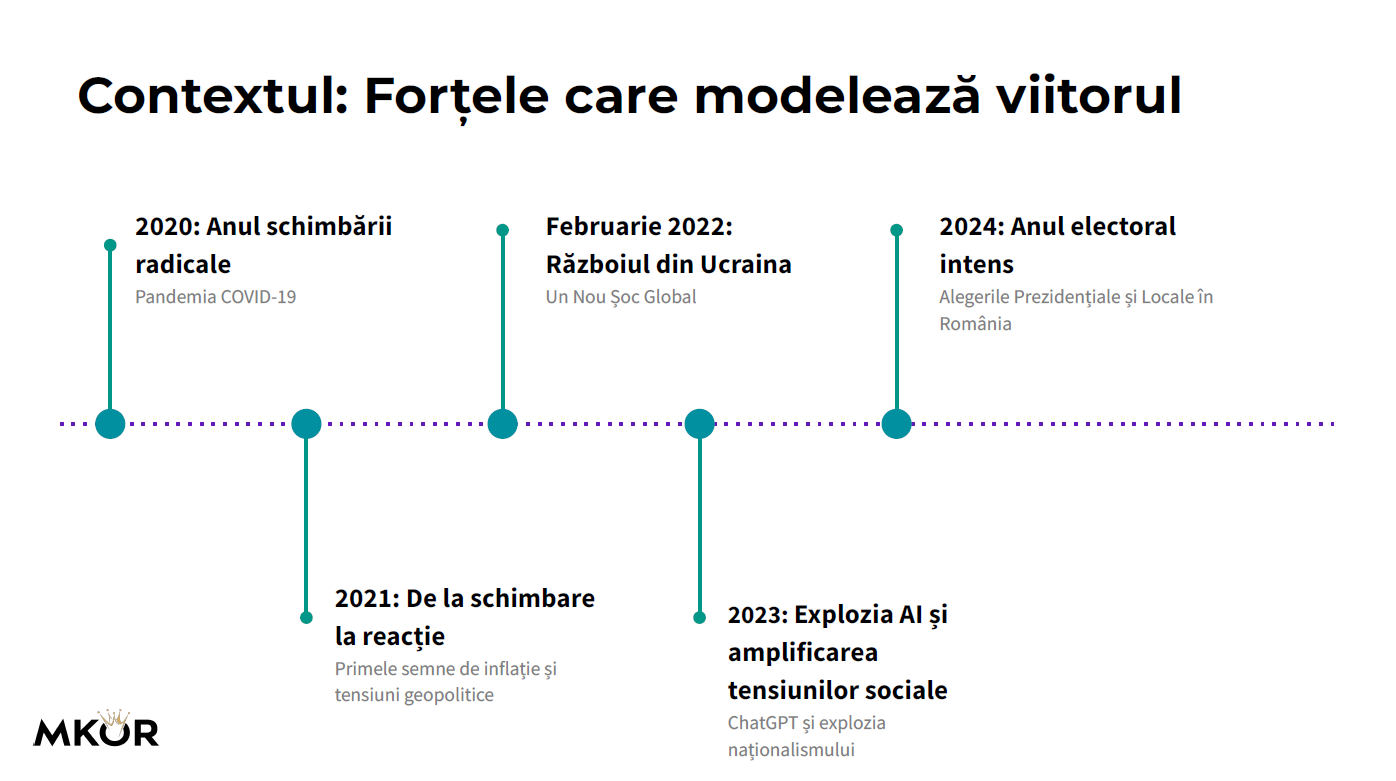
In 2020, everyone was shaken by the pandemic. We all remember that the state of emergency from March to May made us live in isolation for the first time. The fear of illness and the unknown, loneliness, anxiety, technical unemployment, and decreased income increased financial insecurity. Survival was more important than a sustainable lifestyle. There was more talk about reserves of rice, oil, and toilet paper than about reducing waste.
In 2021, the first clear signs of both global inflation and geopolitical tensions became visible. Globally, supply chain blockages appeared after economies reopened, demand increased after the lockdown period, gas, electricity, and transportation became more expensive. And in Romania, we felt price increases for energy, fuel, and food.
In February 2022, the war in Ukraine began. Another shock. Another state of emergency. A new national feeling that "we're not getting out of this."
In 2023, we faced the explosion of AI and social tensions. People are starting to wonder if they will still have jobs or be replaced by Artificial Intelligence; concerns arise about everything we have built so far; the whole world we have built seems to be changing, too suddenly, with too many unknowns, with too much uncertainty. Against this backdrop, nationalism also explodes.
This is what is observed and shocks us in 2024, when presidential and local elections are held in Romania.
In this entire landscape, the number of pessimistic Romanians is also alarmingly increasing. After the presidential elections in May 2025, no one trusts anyone anymore. Neither authorities, nor citizens, neighbors, colleagues; society is divided.
What is left for us to do?
"To be more cautious, less willing to take risks, and more careful about every leu spent," as Corina Cimpoca summarizes.
And this is also reflected in what we choose to buy.
What responsible consumers still buy
Declines were recorded across all categories of acquired sustainable products, from food, coffee, and beverages to cosmetics, cleaning products, and clothing.
However, by far, ethical consumers still mostly choose organic and eco-friendly foods, which contain fewer chemicals and less plastic in packaging, compared to other products.
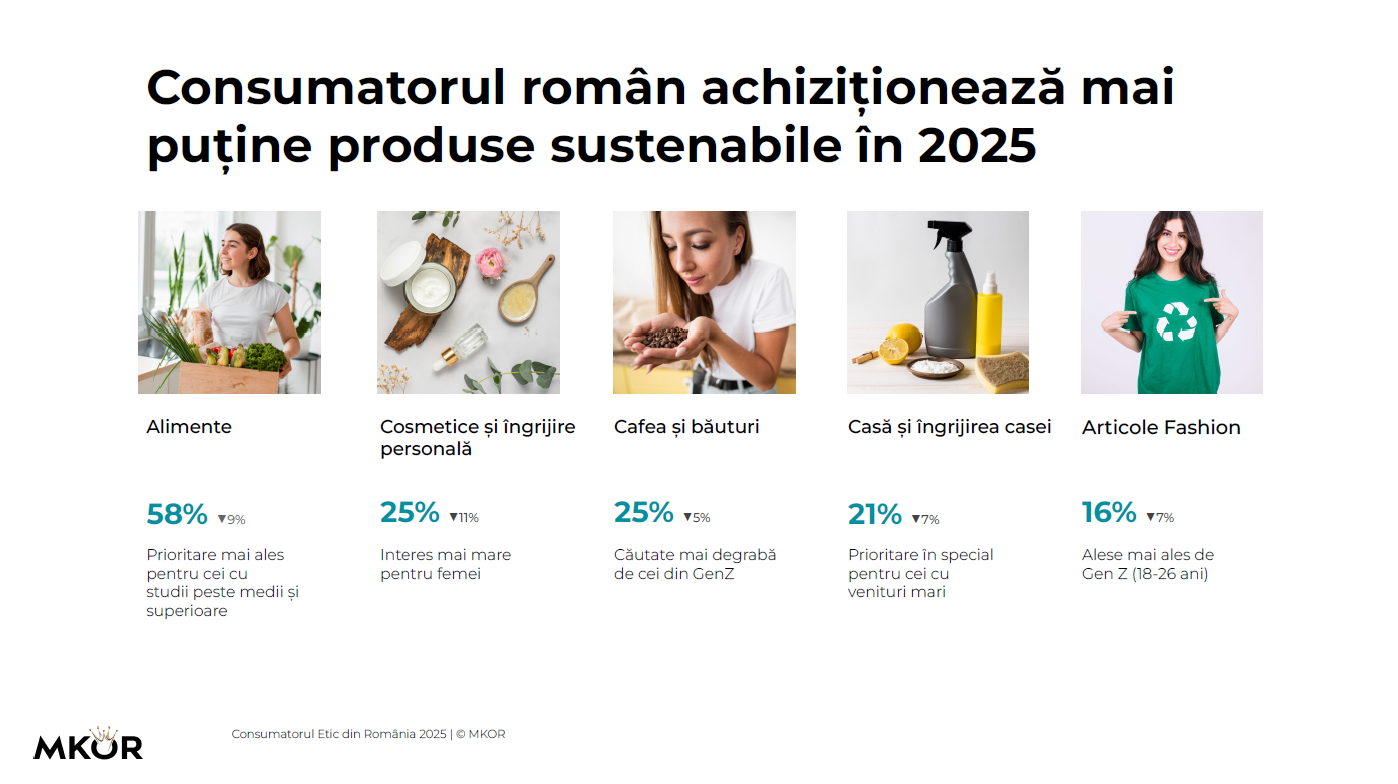
Most such consumers have secondary and higher education, higher incomes, and—as expected—are more likely to be women when it comes to cosmetics and more from Generation Z (born between 1999–2007) when it comes to clothes.
Unexpected is the evolution regarding the gender of the sustainable consumer. If last year we could confidently say that women are more responsible than men because they represented 63% of the ethical consumer segment, this year only 49% of this segment is represented by women. This can be explained by the fatigue and socio-economic context described above.
Also, the age of the buyer who pays attention to what they buy decreases to 38 years old.
78% of these consumers come from urban areas, and 41% of them are parents.
It turns out that the arrival of a child still has this power, even in this tense social context, to make us more aware of our daily actions, the items we buy, the clothes and cosmetics we put on our skin and hair, the detergents we involuntarily inhale in the house, and so on.
Barriers to conscious consumption
The higher price of sustainable products, however, remains the main barrier for 58% of consumers. Practically, against the backdrop of rising inflation and the social and political context, price becomes even more important for everyone.
Next, in the top barriers to a more eco-friendly lifestyle:
-
Lack of trust in the authenticity of eco-labels: 38%
-
Limited availability of eco-friendly alternatives in stores: 25%
-
Reluctance towards companies' sustainability claims: 26%
-
Habit of buying certain brands: 24%
-
Lack of information about the impact and origin of products: 21%
-
Lack of time to search for sustainable alternatives: 19%
It is noteworthy that people's habit of buying certain brands can be transformed into a competitive advantage for companies. An opportunity to change their business model and become more sustainable without fear of losing customers. Because people are more attached to the brand than to the product itself. In other words, loyal customers are more receptive to sustainability initiatives.
How can the business model be changed? A first step could be the implementation of circular economy measures. And fortunately, we already have inspiring examples from various economic sectors that you can consult here.
Ethical fatigue
Even more interesting is the study's conclusion, as interpreted by those who conducted it.
The fact that people bought fewer organic products and paid less attention to their sustainable behavior does not automatically mean they care less about the environment, nature, or sustainable development. They are simply tired. They no longer have the mental space for more conscious choices, for discipline, for any small effort that a more responsible lifestyle would entail.
And this is reflected even in their health choices, not just regarding sustainability. They give up dietary discipline in favor of pleasure and convenience. Not because they don't want to be healthy, but because they are no longer willing to make an effort for their health. And implicitly for their more sustainable lifestyle.
Crisis of trust
The painful truth is this: Romanians no longer have the energy to make good choices. And this is a warning signal for any company that relies on messages of responsibility. And for all of us who want to increase the number of citizens interested in the environment, to reach a critical mass that could put pressure on authorities and companies to change.
But it is also an opportunity for brands and authorities to help people change their lifestyle simply by making sustainable products more accessible: through price, availability in stores, reducing the effort of buying, choosing, selecting, by creating infrastructure for collection and recycling. By offering healthier products, without toxic substances, without unnecessary packaging, "by default," because this is normal, not necessarily because brands want to market themselves as sustainable. People want healthy and sustainable alternatives, but they want them to be "low effort."
And, going further, the most natural step to follow is to abandon greenwashing, misleading green claims. Because the more we lie to people about sustainable products, the more we will actually alienate them from choosing these products. This nullifies all efforts, all resources, all money, and time invested so far by everyone in what is called the green transition.
“We do not have a sustainability crisis. We have a crisis of trust.”
This is the strongest message of the MKOR study, presented at the event Sustainable Day by Day, organized by Environ Association and Eco Synergy. And perhaps the topic for reflection for 2026. How do we regain people's trust? In society, in citizens, in authorities, in sustainability.
The eEco platform tries to take a step in this direction. It aims to become the most trusted sustainability HUB in Romania. Because that's where the lifestyle change and business model change begin, to which we have committed to contribute. From the belief that it is possible, without feeling that we have made enormous sacrifices and without feeling that we are alone on this path.