Photo Gallery
Who should do something about sustainability? This was the key question in a recent study of the urban population in Romania, conducted by AHA Moments and Toknow. The urban and digitized population, to be more accurate, as the study was conducted online.
The firm answer to the question, and why not, even surprising, was ... “ME!”
And this is a piece of information we should delve into, if we take a look at the context and culture.
Context: conflicts, distrust, and isolation
The context is grayish. New and old wars, simmering conflicts, and a growing sense of insecurity. Political uncertainty. Disinformation is increasing rapidly. Artificial Intelligence is developing at a dizzying pace and it seems that no one is keeping up anymore. Jobs, predictability are threatened. Taxes have risen, people are more cautious with money, every economy counts. Social media is becoming increasingly toxic. People are more withdrawn, lonelier, and more anxious. Communities are shrinking, nearing non-existence. Trust in everyone and everything is significantly declining.
And in this context, of ethical fatigue, as another sustainability study concluded at the end of last year, it is understandable why interest in sustainability is also waning.
Even the expectation that someone will do something for the environment, for nature, for the common good, has continuously depreciated over the past years.
Picture slide 9 presentation
If in 2023 people expected the state to contribute to the country’s sustainability in general, at a rate of 68%, this year the expectation for the state to do something in this direction has fallen to 63%.
Trust in local authorities has also decreased from 58% to 48%.
And the expectations that sustainability leadership would be taken over by corporations and NGOs have plummeted as well. From a peak of 58% in 2024 for companies, to 40% this year.
And from 44% for NGOs, to 31%.
Trust in neighbors, in the closest communities, that they can contribute to sustainable development is also decreasing. From 64% two years ago to 45% this year.
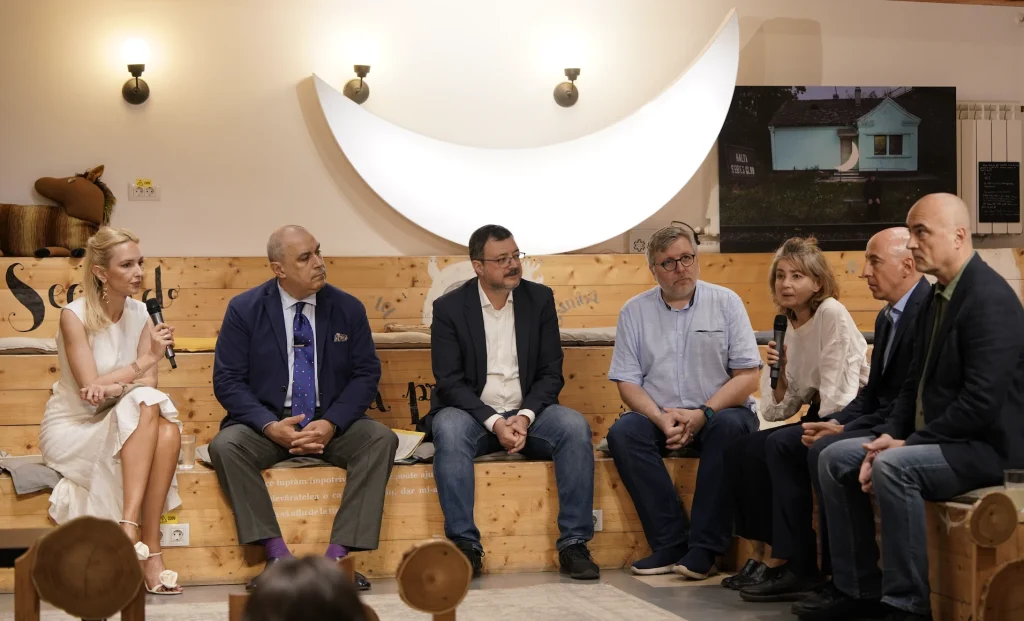
What is surprising in this study presented on the Sustain Ability stage, an event organized by the magazine Progresiv, is the trust that Romanians have in themselves.
The only percentage that does not suffer such a significant decrease compared to last year is the trust in one’s own abilities.
51% of the respondents believe that they are the ones who can significantly contribute to sustainability. More than the community around them, authorities, the state, or the European Union.
Culture: fatalism, risk aversion, lack of personal responsibility
We have a deficit of trust in everyone else, but not in our own forces. And that is news. Because this attitude “I can. I contribute to sustainability” also arises in a country where the culture in which the people who responded to these questionnaires grew up is often one of survival, caution, sometimes fatalistic, excessive conformism, and diminishing the individual and their power to contribute to changes around them.
Let’s take just a few proverbs at random and look at the hidden psychological message behind them:
“The bent head is not cut by the sword.” - It is better to submit than to defend your point of view.
“What is written on your forehead is set.” - Destiny is fixed, you have no real control. You become passive in your own life.
“Make yourself a brother with the devil until you cross the bridge.” - Moral compromise is acceptable for survival. Ethics are relative. Opportunism is welcome.
“At the poor man, not even the oxen pull.” - If you’re in a weak position, nothing goes for you. Let’s internalize helplessness and adopt a victim mentality. Because otherwise...
“Who gets into the dirt is eaten by the pigs.” - If you get into a difficult situation, you deserve the consequences. If you try something new, something different, you risk being harshly judged by those around you. So it’s better...
“Stay in your lane!” – Don’t ask questions, don’t disturb. And, implicitly, have no significant responsibility.
“Don’t stretch more than your blanket.” - Don’t try more than what you already have. Less ambition, fewer risks taken.
“Don’t give away the sparrow in hand for the crow on the fence.” - Don’t risk for something better. You should be afraid of change. Better to stagnate.
“At the praised tree, don’t go with the sack.” - Don’t have high expectations. Easier with optimism. Better to be overly skeptical.
“Where there’s law, there’s no bargaining.” - Authority must not be contested. Never. Not even when it’s wrong. Zero critical thinking, zero problems.
“Whatever the bread is like, it’s still better in my country.” - Accept what you have, even if it’s bad. Let’s conform. Let’s tolerate even what is intolerable.
And climate change, the problem that sustainability actually responds to, and inaction, becomes intolerable.
Of course, these proverbs emerged in historical contexts of survival. But constantly repeated they likely shape a limiting mindset.
Well, it seems that little by little, we are knocking down these limiting mindsets and beginning to understand that change also lies in our hands. And this is already visible in concrete actions, not just declaratively, in studies.
Let’s take two examples. Two pilot projects related to sustainability, whose success also depended on the attitude of consumers, on their willingness to change habits and their own lifestyle.
Pilot Project Tetra Pack. Partial Results
In November 2025, Tetra Pack launched a unique project in Europe, considering its scale, for collecting cardboard packaging for soft drinks and dairy products.
The project was launched in two cities, Bucharest and Brașov. Where, in several partner Mega Image stores, machines similar to those in the Deposit-Refund System were installed, but specialized for these composite cardboard boxes. Likewise, with rewards for people who chose to bring the packaging to the supermarket to be recycled later, instead of throwing it away.
The goal of the project, initially set to last only 8 months, was from the beginning to collect technical, logistical data and consumer behavior data to see to what extent such a project could be scaled. And, why not, to expand the current SGR (link?), where we can currently return only bottles, aluminum cans, and PETs from beverages.
After just three months of the project, the results are promising. Over 3 tons of cardboard packaging have been collected. That is approximately 120,000 pieces of packaging.
70% in Bucharest, as expected. The rest in Brașov.
In fact, Bucharest residents have welcomed this project so well that the company changed its initial plan and opened three more centers alongside the one initially launched in the capital. Thus, there are currently four stores where Bucharest residents can go with Tetra-Pack packaging and other similar cardboard ones. And another four in Brașov:
1. Mega Image CARPAȚILOR, Str. Carpaților, no. 60, Brașov, Brașov County
2. Mega Image CALEA BUCUREȘTI, Str. Berzei, no. 2A, Brașov, Brașov County
3. Mega Image ZIZIN, Str. Zizinului, no. 65, Brașov, Brașov County
4. Mega Image LUNII, Str. Lunii, no. 6, Brașov, Brașov County
5. Mega Image DRUMUL FERMEI, Strada Drumul Fermei, no. 28A, Popești–Leordeni, Ilfov County
6. Mega Image TITULESCU, Bd. Nicolae Titulescu, no. 39-49, Sector 1, Bucharest
7. Mega Image PIAȚA SUDULUI, Șos. Olteniței, no. 208, Sector 4, Bucharest
8. Mega Image PUCHENI, Strada Pucheni, no. 42, Sector 5, Bucharest
In these locations, you can go until May 31, 2026, to return cardboard packaging for beverages and dairy products, regardless of the producing company, with a maximum volume of up to 2 liters, which has been used for milk, plant drinks, juices, liquid cream, or liquid whipped cream. But the list can change, so you can check for any updates here. (link)
To be accepted for return, the packaging must be emptied of liquid, cleaned, not crushed or compacted, with a visible and readable barcode, and with the lid attached to the packaging.
What do these partial results of the Tetra Pack pilot project show us? People want to recycle, they get involved, they have more responsible, more sustainable behavior if they are provided with infrastructure. And yes, perhaps also financial rewards.
Romania, the biggest consumer of Refill cosmetics
Another example. From a completely different industry. The cosmetics industry.
One of the largest cosmetic companies in the world, L’Oreal, present in Romania with 22 brands, is launching globally, including with us, a program called Refill. Through which all 37 global brands of the group introduce at least one product that can be refilled with reserves: shampoos, conditioners, shower gels, lipsticks, creams. For all categories of products, luxury, mass-market, professional, or dermatological.
And what do you know? In the category of dermo-cosmetics, among all 23 markets in Europe where the Refill program has been launched, Romania has emerged as the champion in adopting this Refill program.
The final sales figures are not yet public and cannot be communicated, but the company confirms: Of all the dermo-cosmetics sold in Romania in 2025, the most were in the Refill variant.
What does this say about Romanians? Or, in this case, about Romanian women, most likely?
That they are not in any way inferior to the rest of Europeans in terms of sustainability. On the contrary! Even above them, in some cases.
And that, generally, in all studies conducted by L’Oreal among consumers, Romanians ask companies to be more responsible and to put on the market sustainable products, to the same extent as Europeans do.
The half full
Of course, we can only see the half-empty glass that emerged from the study:
- Sustainability remains an elitist subject, more interesting for companies;
- Ordinary people's interest in the subject and the environment, in general, is decreasing, with so many other problems around;
- There are so many barriers to adopting a more eco-friendly lifestyle, from the high cost of more sustainable products to the nonexistent infrastructure;
- Promotions are becoming increasingly aggressive and contribute to food waste, and people often fall into their trap;
- Young people (18-25 years) are harder to attract to sustainability because they associate it with too much discipline, too little fun, and too little technology.
But I choose to see BOTH the half full.
For the first time I hear Romanians being talked about as self-assured, whole citizens, with self-esteem, aware of their value and the power they have in society through their everyday actions, through their vote every time they take out their wallet to pay for something.
The same Romanians raised with “Don’t give away the sparrow in hand for the crow on the fence” choose, it seems, to risk perhaps comfort for something better. They choose to take a package for recycling if they have the opportunity. And they choose to reuse a container for cosmetics if they can. Of course, with a financial advantage. But perhaps even the fear of change is not so great anymore.
And perhaps we are slowly understanding that change truly begins with us.