Swans on the Lake
On April 19, 2023, the Sustainability Embassy organized a conference on "Sustainability: between responsible communication and misinformation." One of the four invited speakers on the subject was Valer Hancas, presented as the director of IAA (International Advertising Association), but who is also known to be the communication director of Kaufland.
At that time, when Valer Hancas was speaking to the audience about the importance of responsible communication from companies to combat misinformation in the form of greenwashing (false, misleading, unfounded, or incomplete claims about the green attributes of a product, service, or commercial activity), Kaufland was running its extensive Zero Waste advertising campaign, a campaign itself accused of greenwashing.
Do you understand?
Because of this campaign, I initiated this endeavor to discuss greenwashing in detail. Because it seemed to me that things were going too far. And behold, this is why you are reading this article.
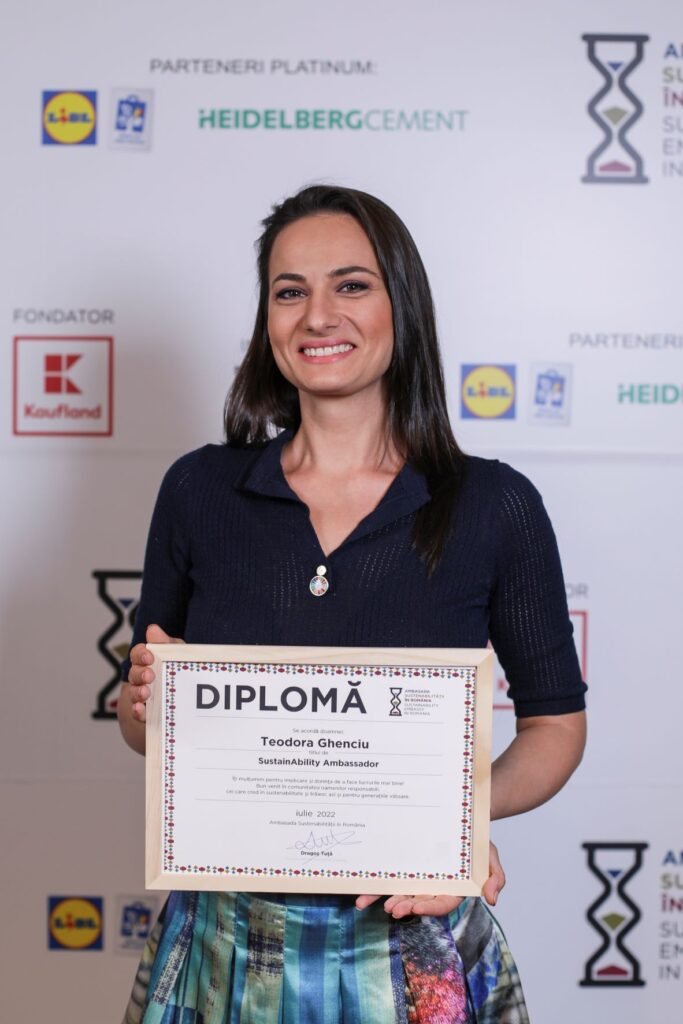
Don't think my fingers aren't trembling on the keyboard as I type these words. I myself received a diploma as a sustainability ambassador from the Sustainability Embassy. The Sustainability Embassy is where I discovered what the concept of sustainability means. So the emotional charge is high.
How to forge sustainability alliances without being accused of greenwashing
But let's set emotion aside and engage the rational part of our brain. I was determined to talk to a sustainability expert about partnerships between NGOs/public figures/specialists/governmental institutions and corporations. I wanted to find out how we should approach initiatives like those organized by the Sustainability Embassy — discussions, awards, webinars, colloquia — because several such projects have appeared recently.
Do we simply stop partnering with companies considered major polluters? Or do we partner with them, hoping to change things from within? Or do we partner, but under certain conditions, depending on the project? Is it a matter of personal choice, or is there a code of conduct to follow, regardless of the context?
Here's what Vasile Lazar, a sustainability consultant, told me: "Situations vary from case to case. Of course, a company is not condemned to be a greenwasher forever. Any effort a company makes in the field of sustainability is commendable. It's good. Provided it doesn't become a greenwashing effort in terms of communication.
The problem arises when these alliances appear between non-governmental organizations — which should rather be organizations that raise public awareness about sustainability and educate them to understand what greenwashing is, when it occurs, how it can be discouraged — and those they should supervise and warn not to greenwash."
The fine line between reality and greenwashing
Sometimes, things are even more complicated than that. Seemingly environmentally friendly actions, such as cleanup or afforestation initiatives, are blamed simply because they are sponsored by "major polluters," as some environmental activists have called companies with a large carbon footprint.
A famous partnership that raised questions is the one between WWF, one of the largest global environmental NGOs, and Coca-Cola, one of the biggest polluters due to the vast number of plastic bottles it places on the market, from which it only manages to recover a small fraction for recycling.
This partnership, called "Together for the Danube," led to the creation of a new delta in Romania, Garla Mare, in Mehedinti county, by restoring a wetland area. Wetlands are very important for biodiversity recovery and for fighting climate change.
https://eeco.ro/wp-content/uploads/2023/05/imported-be1460687b8fb564a10c35a792beed28.jpg
A commendable endeavor, which was even named "Partnership of the Year" at the Reuters Responsible Business Awards in 2020.
So why is it controversial?
Vasile Lazar, sustainability consultant: "These partnerships are not viewed favorably because such companies have a history of delaying decisive actions to reduce their environmental footprint. That's why the level of trust in such partnerships from activists is low.
I think companies' efforts to help restore rare areas, rewild areas, clean beaches, riverbanks, and so on are laudable, good things, and it's good that they are happening. However, we are somehow acting at the end of the pipeline. These are 'end-of-pipe' solutions. Of course, they are good and bring environmental benefits. Any action, any piece of paper picked up and placed where it belongs, is commendable, it is good. But we should be working upstream, at the cause, at the source of the problem.
In the United States, a program has been adopted since the 1970s, before this issue of waste prevention, pollution prevention, and clean production directive appeared in Europe. And there, for years, they encouraged company practices to redesign, rethink concepts, product designs, rethink packaging, rethink the products themselves, the services themselves, in such a way that they have as small an environmental footprint as possible.
I would like to see a partnership between any governmental organization and such a company that has a large environmental footprint on something like this: 'Look, we've brought in some sustainability specialists to sit down with us and look at our products and redesign them in such a way that they are more environmentally friendly.'"
So, here is the key in this seemingly fine distinction between responsible action and greenwashing: measures taken rather to rethink the business model, which causes the problems, and not just remedial measures for what can still be remedied.
These are not just the expectations of specialists from companies that are hell-bent on positioning themselves in the market as the most sustainable, the greenest. But also of ordinary people, who are beginning to understand deceptive communication tactics better and better and reject them.
This is also the reason why I started this unique initiative in Romania, to explain the phenomenon of greenwashing. So that we all learn something from it. Companies, how to communicate more responsibly, and people, how not to be so easily fooled.
This is the fourth case study I have conducted with sustainability consultant Vasile Lazar on the topic of greenwashing. In total, there are six concrete examples.
The first case study was about the Kaufland Zero Waste campaign.
The second case study was about the KLM, Fly Responsibly campaign.
The third case study was about the TotalEnergies Net Zero campaign.
The remaining examples will be published in the coming days, here, on eEco. And finally, the full interview.