Kaufland Greenwashing Protest
In April 2023, Kaufland launched an extensive communication campaign, announcing that it was the first company in Romania to be certified Zero Waste.
The campaign quickly drew criticism from journalists and environmental activists, entrepreneurs selling zero-waste products, and the eco-conscious public.
The main accusation was false advertising. And the primary concern stemmed from the company's size; Kaufland is one of Romania's largest employers, with 17,000 employees, 160 stores nationwide, and probably hundreds of thousands, if not millions, of customers who frequent their stores. These customers received this advertisement in stores or by mail, which you can see by watching the video interview.
"If a company of this size engages in such widespread misleading advertising, on TV, radio, and in the streets, and it goes unnoticed, we will be deceived daily by anyone, anytime," was the prevailing thought.
https://eeco.ro/wp-content/uploads/2023/05/imported-e364e26b9edb33c31be881b6c50c6b78.jpg
The issue escalated to such an extent that at a conference held by the company to announce its entry into the Guinness Book of World Records for the largest T-shirt made from recycled plastic bottles, several environmental activists boycotted the event and protested, displaying a banner with the word GREENWASHING written in large letters. In front of cameras. In front of journalists.
Greenwashing is the term for marketing strategies where companies attempt to appear greener, more ecological, and more sustainable than they actually are. It is an important issue for the European Commission, which recently proposed a directive to drastically penalize such campaigns, with fines up to 4% of turnover.
Activists hoped that this would make the topic important for Romanian journalists as well. However, the television stations present did not cover the story. They did not report on the protest.
Following the article published on eEco, Kaufland, however, issued a right of reply. It addressed some of the accusations. But not all.
And because the discussion had already spread into the business community, which was naturally interested in learning an outcome from which it could also learn something, I persistently urged the company, from the CEO and communications director down, to grant either an interview to answer all remaining questions, or to organize a broader debate on the wider topic of responsible communication, so as to turn a scandal into something constructive.
To learn something from this together. And the Zero Waste campaign would be just one of several case studies. Not a pretext to denigrate Kaufland.
Kaufland refused further explanations
As the response received from the company was negative and the topic seems to be of public interest and unresolved, I really wanted to draw a conclusion and turned to a sustainability expert with over 20 years of experience in the field.
I wanted to understand how a commendable effort, the intention to certify part of its own waste management system, turned into a criticizable action that, ultimately, backfired on the company.
Where did Kaufland go wrong? Is their communication campaign greenwashing or not?
Vasile Lazăr, sustainability consultant: “By all criteria used in discussions about greenwashing, their campaign qualifies as greenwashing. This is because these marketing tactics use certain communication tactics. Through which they either omit to state all details about a certification or about a claim - that they are green or greener than others or the first to be green in that field - or to explain the context, the area to which the certification applies, the specific performance level certified by an independent body. And in almost every one of these points, from my point of view, Kaufland made a mistake.
They also distorted information, because, on the one hand, they didn't say what the maturity level of their waste management system is, and on the other hand, they didn't specify the operational area covered by the certification. We only know some things, which even today remain vague. What does operational waste mean?"
Kaufland’s communications director, Valer Hancaș, sent me at one point, in the email exchange through which I was trying to get more reactions, the certificate that sparked the entire controversy. After which he informed me that from their point of view, no additional information could be provided on the subject. Because they had already made available to those interested all examples and details to help clarify things.
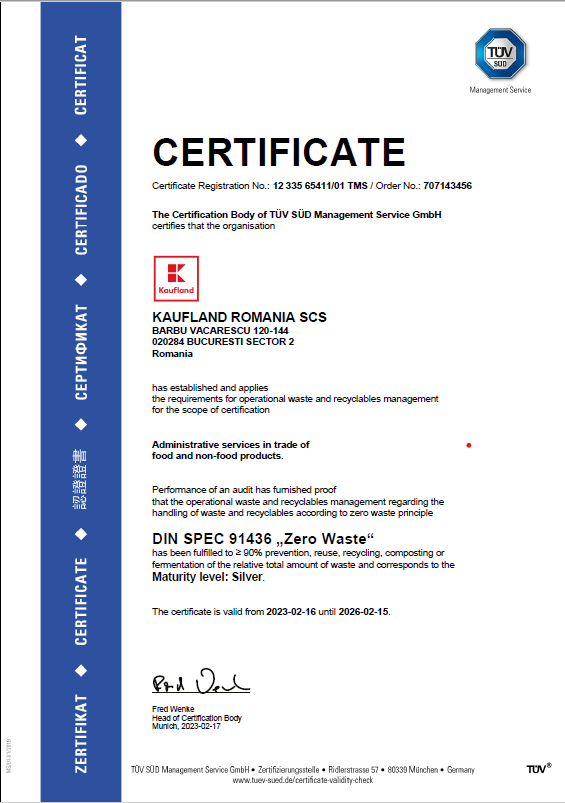
Indeed, the additional information, which we did not have access to until now, is the "Silver" maturity level stated on the certification document, but which was not made public in the Zero Waste campaign.
Vasile Lazăr, sustainability consultant: "You see, here's the problem. The problem is that when you come and present to the consumer that you are a Zero Waste company, without specifying the concrete level of performance achieved, the consumer is left with a different impression than they would have if they had all the information.
As an ordinary consumer, what is understood by the Zero Waste slogan is one thing. And something else would have been understood if, alongside that slogan and the logo of the certification body, the Silver level had appeared. We all know that silver is not the most expensive metal and that, as a rule, when we talk about levels of maturity or performance, Silver is not the same as Zero. Or it's not the same as the most performant.
In itself, the company's performance in managing to reduce 90% of waste from any part of its operations is commendable. It's a good thing. But it's not the same as saying Zero Waste."
The Kaufland Zero Waste campaign is just the first case study I conducted with Vasile Lazăr, along with five other concrete examples of greenwashing, in an attempt to explain the phenomenon as practically as possible. Why it is dangerous. Whom it affects and how. How companies can avoid such accusations. How people can detect when they are being lied to.
All six case studies will be published one by one, here, on eEco, in the coming days. And finally, you will be able to watch the full interview. For now, just an excerpt.