Debate on Trees in Bucharest
This summer, many of us have noticed more dried trees in parks, green spaces, and along streets. As Bucharest becomes an increasingly polluted city exposed to extreme temperatures, we need mature and healthy trees more than ever. Their absence affects our health and quality of life. We are in a state of ecological disaster, and urgent action is needed.
At the event on Thursday, October 3rd, at NOD makerspace, Splaiul Unirii 160, Bucharest, the organizers, Platform for the Environment for Bucharest and the initiative group Healthy Green Spaces, offered a space and a voice to experts, local authorities, and community members to explore the most pressing issues and identify urgent solutions.
Education for all of us, best practice for authorities
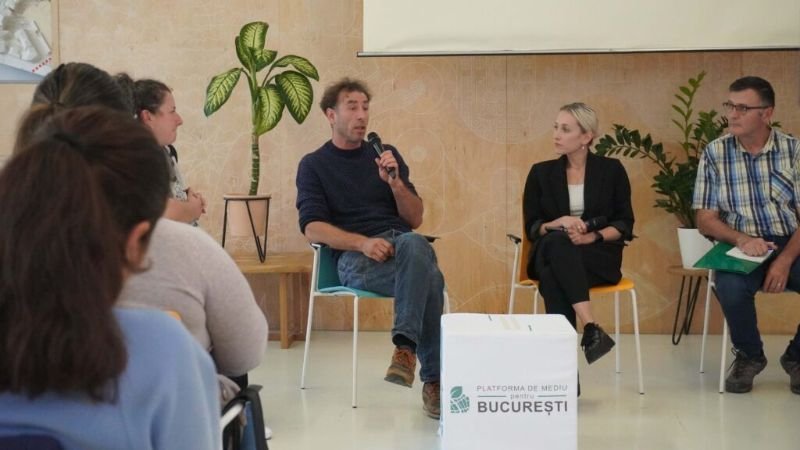
The invited guests, Diana Culescu, a landscape architect, and Alexandru Purcaru, an arborist, along with moderator Laura Popa, a PressOne journalist, concretely presented the causes of tree degradation in urban environments, with examples from Bucharest, as well as prevention and intervention measures, and the essential partnerships for efficient green space management.
Measures were presented that must be taken immediately to protect existing trees, what is already too late to save, and most importantly, how we can prevent a future ecological disaster in our cities, with the most crucial step being the urgent implementation of the Green Registry.
Who was present from the authorities?
The invitation was answered by and speeches were given by: Magdalena-Maria Anghelina, from the Green Spaces Maintenance Service, ALPAB Ioana Cătuneanu, personal advisor to the General Mayor for environmental issues Tudorel Popa, Bucharest Plant Protection Service.
For more information, we invite you to access Diana Culescu's presentation here and watch the recording of the entire event here.
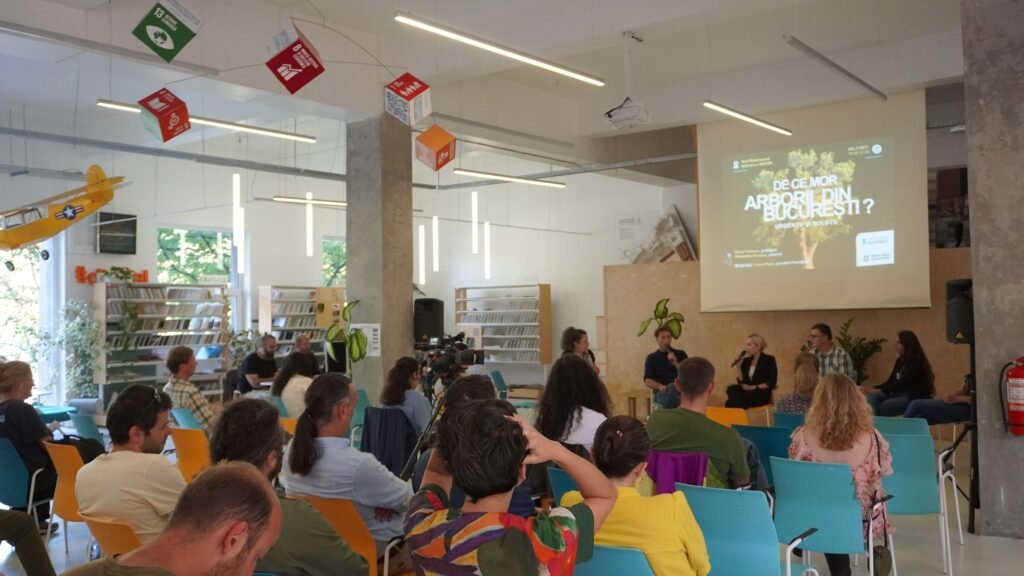 Photo: Andrei Leonte
The debate brought together active specialists in the field, people from institutions and administration, civic groups, all aware that the trees in Bucharest are in a crisis situation.
The event began with landscape architect Diana Culescu's presentation, from which we learned an enormous amount.
While the answer we have received so far from institutions is that trees die of old age and climate change, Diana demonstrated that human actions also have a significant negative impact:
- interventions in the crown with chainsaws under the invented title "pruning";
injuring or cutting roots;
"sanitizing" the soil by removing leaves and leaving the soil bare, unprotected by vegetation and organic matter;
soil compaction, which prevents its aeration and thus affects the roots,
are just a few of the actions that lead to tree decline.
In fact, at the top of the list as an answer to the question in the title, Diana Culescu placed "lack of qualified personnel in the field and in offices, lack of specialized equipment." Also, the absence of a Green Registry weighs enormously in the equation of a city with healthy trees.
Alex Purcaru, one of the very few internationally certified Romanian arborists, believes that we still don't know perhaps even 20% of the functioning mechanisms of trees, but abroad there is a tree management that yields results.
The discussion became lively, with a series of questions addressed to institutional representatives. There is a sharp difference between Bucharest and European capitals in the way green spaces are managed, and it seems that the fight to reach a decent level cannot even begin: institutions lack personnel, lack specialists, the General Mayor's office does not have a long-term green space management plan, we do not have regulations, laws, local council decisions to rely on.
We have over 1 million trees, and we will most likely have to start from scratch. The optimism from the meeting comes from the fact that there is a will to start from this point, there are people in institutions who want to change things, and the debate ended with the idea of continuing the dialogue, meetings, and searching for solutions.
What is the "Green Registry" and why do we urgently need it? The "Green Spaces Registry" is documentation compiled to record and quantitatively and qualitatively manage green spaces in a city. Because it ultimately represents a real-time mirror of the green spaces situation, this report is the cornerstone for correct and coherent administrative policy towards developing natural heritage.
What next? A series of actions, webinars, and events will follow, which will be announced on the Healthy Green Spaces FB page and on the eEco.ro platform to support authorities in accelerating correct measures for healthy management of trees and green spaces.