Community Composting Site
It's been about two years since I've been thinking about composting. And I'm still just thinking... Although I live in a house and have a small plot of land, and I've read quite a bit about how to do it, something is holding me back. I still live in a residential neighborhood. What if it smells? It seems complicated, from everything the experts explain. Or maybe I've read too much? These kinds of thoughts keep me stuck. And that really annoys me.
What is compost
According to DEX (The Explanatory Dictionary of the Romanian Language), compost is a natural agricultural fertilizer, resulting from the slow fermentation of various plant and animal residues, mixed with some mineral substances.
 Photo source: Facebook/Încotroverzi
Why I want to compost so badly
I've wanted to compost ever since I realized that more than half of our waste consists of these plant residues. Fruit and vegetable peels. Which could nourish the soil, instead of being a huge waste. On the one hand. On the other hand, they are also a major source of pollution. Because once they reach the landfill, these seemingly biodegradable residues, mixed with all other waste, in industrial quantities, without oxygen, are no longer biodegradable. What's more, they start producing all sorts of toxic gases, including methane. Twenty times more dangerous than carbon dioxide, which we talk about more often and seems to scare us more.
Composting is therefore the most accessible way for me, an honest citizen, to directly contribute to reducing greenhouse gases, responsible for global warming. What extraordinary power I have! We have! And what a pity we don't use it!
Compost can also be made on a large scale
Then, compost can also be made at an industrial level, not just individually. For a heap of other reasons:
- From what we throw away, high-quality natural fertilizer can be produced. And maybe that way we'll replace some of the chemical-based fertilizer. Which we have become dependent on and which we import.
- This natural fertilizer helps regenerate soils. Especially in areas undergoing desertification. Romania has a big problem in this regard.
- Compost increases the soil's water retention capacity and thus reduces the need for irrigation of agricultural land.
- Around this compost, an entire circular economy can develop. Businesses, then, and new jobs, throughout the chain: compost producers, those who certify the product, distributors, sellers, specialists to teach others, etc.
If it's so good, why doesn't the state do it?
All these reasons are actually the basis of a compost law, which also exists in Romania. And which obliges us to dispose of organic waste separately from the rest of the garbage. To practically have five bins for waste: plastic, glass, paper, household waste, and organic waste.
The law appeared as a result of a European directive. But apart from ticking the box that we had done our duty to issue the text of the law, we did not rush to make norms. So, the law is not applied. For now.
Under these conditions, I was very happy to find out that there is another way. A middle ground. Which doesn't involve me making compost in my backyard. And there's no need to wait for the state to do something. This path is called community composting.
What is community composting
 Photo source: Facebook/Încotroverzi
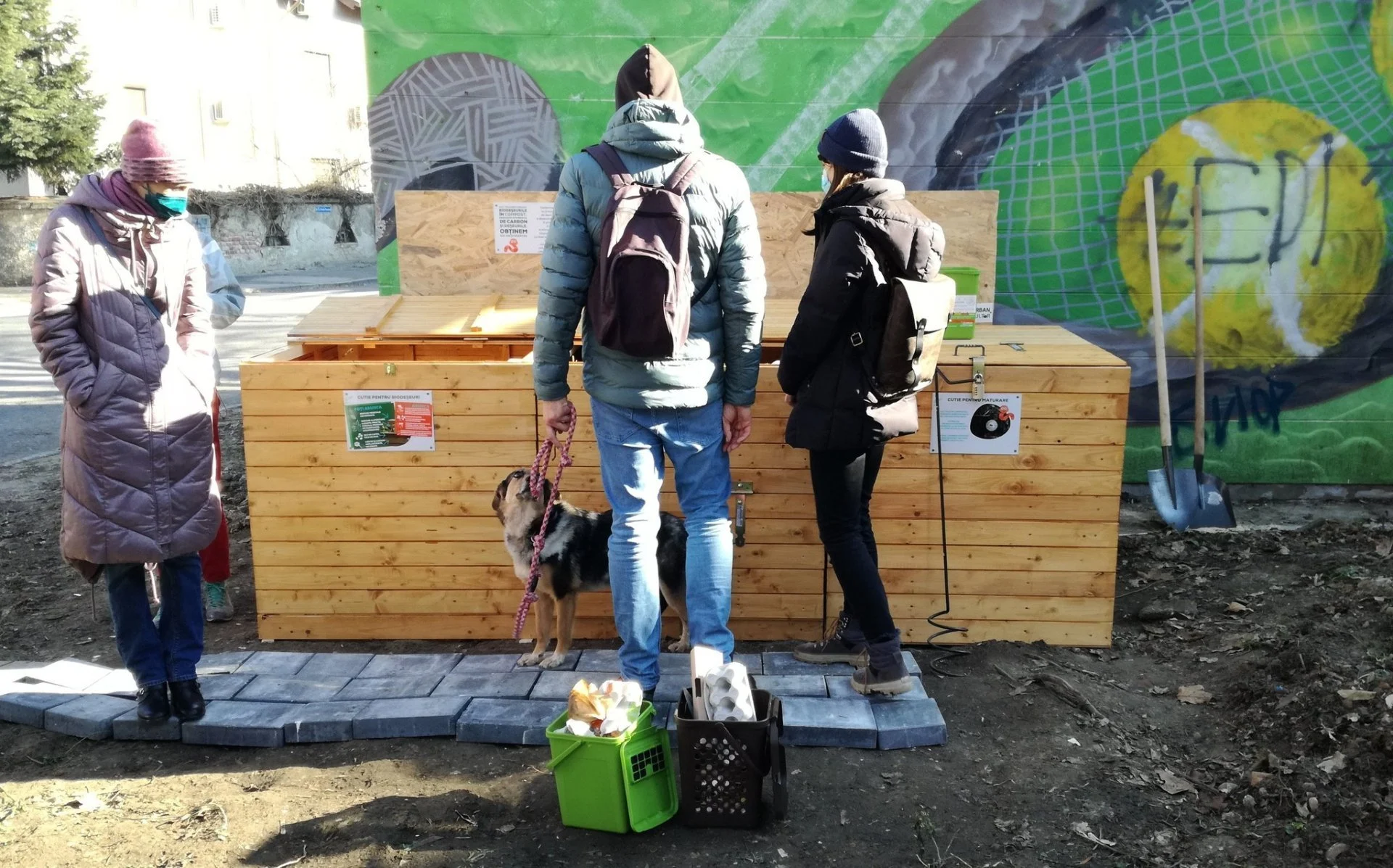
Community composting means making compost together. Obviously. Not in your own home. But not all together, as the state would do. Because this industrial variant also comes with some problems. Composting would be done in small communities, as has been happening for about two years now through at least three pilot projects started in Bucharest.
- One in Sector 4, at Community Orchard
One in Sector 2, in Floreasca, carried out by Urban Cultor
One in Sector 5, done by Incotroverzi
Small communities mean a few dozen families. Ten, twenty, at most thirty. People who come, once a week, for example, to a fixed point, close to their homes, with the plant residues they have collected at home.
For community composting, simpler, safer recipes are used. Primarily fruit and vegetable peels are added, finely chopped. Not eggshells or leftover cooked food, which might go into another type of composting, individual (which people can do on their balcony or in their yard) or mass, as would happen if the law were implemented.
Each person who comes to this fixed point has a code for a lock. They dump and leave. The fact that it's voluntary and that the whole process is turn-key means that over 90% of what is dumped there is exactly what it should be. No plastic, no bags, no other nonsense. Possibly, some waste that got mixed up by mistake.
What's the point of community composting if it's not on a large scale
Community composting is not meant to replace industrial composting. Even if the law were applied tomorrow and we were obliged to also throw biodegradable waste into a specific bin, it would still make sense to have such smaller-scale projects.
 Photo source: Facebook/Mărțișor Community Orchard
In France, where industrial composting has been going on for 12 years, such projects are supported and encouraged by the state because they have a very important educational role. People learn how to dispose of things, what is biodegradable and what is not. But also a role in raising awareness. If they see others doing it, maybe they'll want to do it too. In the psychology of change, it seems that such tricks - like presenting a specific example - succeed in moving things on a larger scale. It's proven that in a neighborhood, for example, if one neighbor installs solar panels, the chances of other neighbors installing panels increase significantly.
Probably following this principle, the French state also manages to collect vegetable waste better at a macro level by supporting educational projects at a micro level. Because even in France, even though 12 years have passed since organic waste has been disposed of separately, education is still needed. As everywhere.
The problem in Romania is that currently this type of composting happens somewhat informally. The new compost law does not include this notion of community composting. And the old legislation, which is actually applied, neither prohibits nor mentions this concept anywhere. So those who took the trouble to obtain approvals for such things from mayors or from institutions that owned the land wrote "advertising space" or "service provision" in the documents. Not composting. Not urban. Not communal. Which means they also pay taxes for a good deed they are doing for both local authorities and all of us.
How to implement community composting near your home
Until the authorities decide if and how to support composting at the source, it is certain that such projects can be implemented. Even without having an NGO or a company. With a little effort, admittedly, but it's not impossible. The first steps to follow:
- Talk to people in the community and determine if there are at least ten families who would be interested.
Identify the land where the bins could be placed. Three of them.
Obtain written approval for placement.
Establish a project manager. Or several.
A small training course where managers learn how to do the job. And be able to teach, further, those who will dispose of their waste there.
The good news is that there are people passionate about the subject, experts in the field, who are willing to teach others. So if you are interested in this aspect and would like to implement such a project in your neighborhood, you will not be alone. You can join this community and find all the support you need there.
Good luck!