Photo Gallery
The printing company in the world, Xerox, has been present in Romania since 1968. At that time, 5 copies were made per minute. Currently, approximately 140 pages are made per minute.
Printers are becoming more and more efficient, but customers are printing less and less. To meet sustainability requirements, companies are trying to reduce paper consumption, among other things.
Print is dead. Long live print
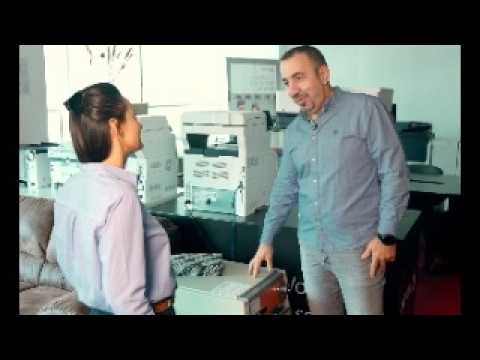
So customers need to be attracted differently. How exactly, I asked Ionuț Baciu, indirect sales manager at Xerox Romania.
I've been asked by friends and acquaintances, "Sir, still at Xerox? But hasn't print disappeared? Now, with all this digitalization? What do you do? Do you still work? I mean, does Xerox still exist?" Yes, the answer is yes. Xerox exists and will exist for a long time to come. We even have an expression, "Print is dead. Long live print."
Why? Because over these 20-something years, we have reinvented ourselves. And even if you might think that print is disappearing and we're going to go bankrupt, well, no. We made sure to do these things in a correct business manner. To reinvent ourselves, to transform ourselves.
The first transformation: changing the business model. From selling products to selling services. In the 90s, the company introduced the concept of printing services in Romania for the first time. Customers no longer have to buy equipment;
they just rent it. This way, they also get rid of the hassle of repairs and recycling at the end of the life cycle.
The second transformation of the business model: digitalization. From a manufacturer of tens of kilograms of printers to a manufacturer of lighter, multifunctional equipment, which incorporates dozens of software applications.
Basically, through multiple internally developed digital solutions, the company that invented the first photocopier actually helps its customers to no longer photocopy.
A paradox explained by Bogdan Cobuz, printing services manager at Xerox Romania.
Yes, it's somewhat of a paradox. Because it's a market reality: printing volumes are decreasing, and it's normal for this to happen. Xerox, a leader in this field, tries to protect itself and not lose its interest or customer coverage. For this reason, we have created a multitude of software applications that our customers use to improve their daily work in the office, increase their productivity, and enhance their security. And very importantly, we help them become sustainable.
By modifying processes and through technology, a century-old company manages to remain relevant. Because from a printing partner, it becomes a digital, security, and sustainability partner.
In 2024 (it was mistakenly written as 2014) the company managed to launch 40,000 printing equipment units on the market. An increase of 10% compared to the previous year.
The change in business model through digitalization and the sale of a "product as a service" is the topic of episode number 15 of the campaign"Second Life. Circular Economy Models", carried out by Asociația Soluții Sustenabile with the help of the environmental consulting company Stratos. A project initiated with the goal of accelerating Romania's green transition by providing examples of good practice from the business environment.
The other 14 episodes can be viewed here.