Recyclable Packaging Sorting
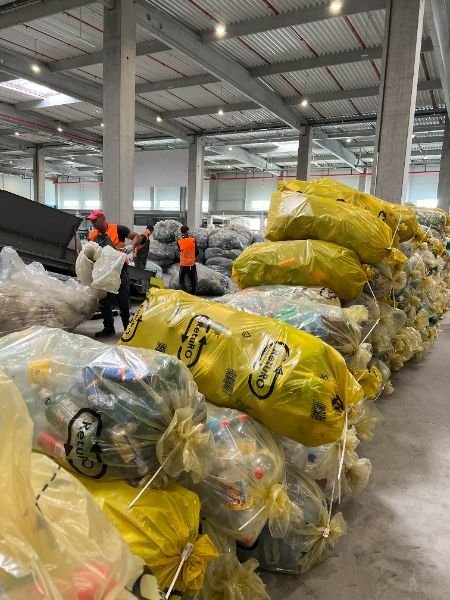
Five million packages per day, which the Environment Minister says are collected in those supermarket machines, is an impressive number, no matter how much you want to grumble about the Deposit-Return System. These are PETs, aluminum cans, and bottles that we no longer see in fields, on riverbanks, or in lakes, but are neatly and civilly gathered at a sorting center and then sent for recycling.
Of course, this figure of five million must still be compared to the enormous quantity of beverage packaging placed on the market. That's seven billion packages annually. So, if the collection rate remained at five million packages per day, it would indeed be too slow a pace; we would collect too little. Too little compared to those seven billion.
But the pace is increasing month by month. For example, in the first three full months of 2024 – January, February, March – approximately 100 million packages were collected. And in one and a half months, April plus half of May, 250 million packages were collected. So, a 150% increase in such a short period, I would say, is encouraging.
This is where our role comes in. The citizens' role. Because we can directly contribute to increasing the recycling rate of waste in Romanian cities. Which, as you know, is shamefully low, averaging around 12-13%.
Certainly, we could have contributed before, simply by separating waste. But since the data wasn't as transparent and reported monthly, the feeling of contribution wasn't as tangible. And no, this doesn't mean I'm putting pressure on citizens, on the poor citizen who often seems to have to take on all the responsibility of the state or companies.
It is obvious that the state, companies, and the system must do their part. It is obvious that we must also have functional infrastructure so that we can increase the separate collection rate and achieve our recycling targets. It cannot be otherwise. But even if we had the infrastructure and people didn't use it, it still wouldn't be good.
That's why I don't think I'm exaggerating when I say that it seems to me that for the first time, citizens can feel empowered, through their individual, visible, measured contribution, to a common, national goal.
"We want to, but the system doesn't work!", will probably say those who have encountered all sorts of problems when trying to return packaging. From blocked machines, retailers who refused to accept bottles, to stores that refuse to give money or flatten PETs, claiming lack of space. Let's take them one by one!
I've already written about the first two issues in a previous article, which I invite you to read here. Now let's focus on the next two.
Merchants who refuse to offer money
I hear that there are situations where people make the effort to take bottles with the "Returnable packaging" logo back to the store, but there, instead of receiving the equivalent in lei on the spot, 50 bani for each package, they receive a shopping voucher.
It's true that the machines in hypermarkets can only issue vouchers, they can't dispense cash because they are not ATMs. But with that voucher, the person can go to the cashier and ask for cash, if they wish. It's their choice. The merchant receiving the packaging should not force them to buy from that store.
Moreover, the consumer can request that the money be transferred directly to their account, if they prefer not to have cash. However, in this case, they must bear the bank fees.
I asked RetuRO, the DRS administrator, what people can do if they experience this, if their right to receive money, cash or by card, is refused.
Anca Marinescu, Corporate Affairs and Communication Manager at RetuRO:
"First and foremost, they should signal that they are at a point where they are not complying with the law and that it is very important for all of us to respect the law as long as we live here and claim we want a better life.
But I believe it's a moment when, truly, retailers, some of them, don't understand.
We can contact the retailer and tell them, look, I've been informed that at your store, vouchers are not accepted. You know you're breaking the law, you know it's not right. At least let's try to explain to them again. We are doing a lot of education with retailers right now. I have colleagues who go into the field and talk to each of them. Over 20,000 retailers have been visited so far. And the universe we are targeting is 50,000 retailers."
The problem of intact packaging
Also on the dissatisfaction chapter, I noticed that some people don't like the rule about not crushing packaging. If it's any consolation, in all 15 countries where a Deposit-Return System has been implemented, collection is done in the same way. Packaging must be intact, undeformed, so that the barcode can be read. For a very simple reason, explains RetuRO, to avoid fraud.
"There is a risk that if you crush them, when they arrive at our centers, they might not be recognized. Because at our RetuRO centers, the equipment that performs this counting is also automated, like those at RVM.
They are the same machines, set up in the same way. They have the same backend settings. So, if your package is crushed, there's a risk that its barcode won't be visible, it won't be recognized, and you won't receive the money for that package, the deposit, and the handling fee.
Ultimately, it's also in the merchant's best interest," says Anca Marinescu.
Therefore, there are no exceptions. Regardless of whether you are a small merchant and say you have too little space and nowhere to store PETs, cans, and beverage bottles, you are not allowed to crush them.
Why Romania is different
We are not "more Catholic than the Pope" when it comes to packaging collection, and yet there are some peculiarities in Romania regarding the Deposit-Return System.
Firstly, we are the second largest country to implement such a system, after Germany. However, unlike Germany, where collection is done by states, here it is done in an integrated manner, managed at a national level.
"RetuRO is a single operator at the country level. We have a different geography. We are quite spread out in terms of area compared to other countries that have implemented it, Slovakia, Malta, Ireland. These are much smaller countries. We are talking about huge volumes of packaging compared to other countries. Seven billion packages that we have estimated annually, compared to two billion in Slovakia, for example, less than a billion in Ireland – completely different volumes.
Then, what makes us special, truly special, is the way we organize trade. Because in most countries, we are talking about modern trade, meaning large chains of hypermarkets, supermarkets, in about 80% of cases. Which makes the system much easier to implement. In our country, the proportion is only 50%," Anca Marinescu, Corporate Affairs and Communication Manager at RetuRO, tells us in the video interview.
This explains why over 90% of collected packaging comes from machines, even though the law doesn't require us to collect it only this way. Collection can also be done manually. This would especially help small stores. But there is still reluctance there, especially in rural areas, where sellers lack space and where the DRS seems like an additional burden.
Who are the recycling champions
The "Hora" of recycling has thus far been danced mostly in cities, where, ironically, I don't know how many people still know how to dance traditional folk music.
Between January 1 and April 15, 2024, the recycling champions were, as expected, the residents of the capital and its surroundings, followed by large cities, which also have large stores.
Collected packaging
Bucharest: 38 million Ilfov: 10 million Timis: 9 million Cluj: 8 million Constanța and Brașov: 7 million Prahova and Mureș: 6 million
However, there's still a long way to go. And yes, maybe Romania has many peculiarities, we are a pretty big country, we produce a lot of packaging, we have many neighborhood stores, but that doesn't mean we should be different in terms of results. If everywhere it was implemented, the system started to perform well from the second or third year of operation, when the collection rate in many cases approached 90%, I don't see why we should be inferior.
All we need to do is manage to bring the "hora" back to the villages. And to get even small stores to collect.