Photo
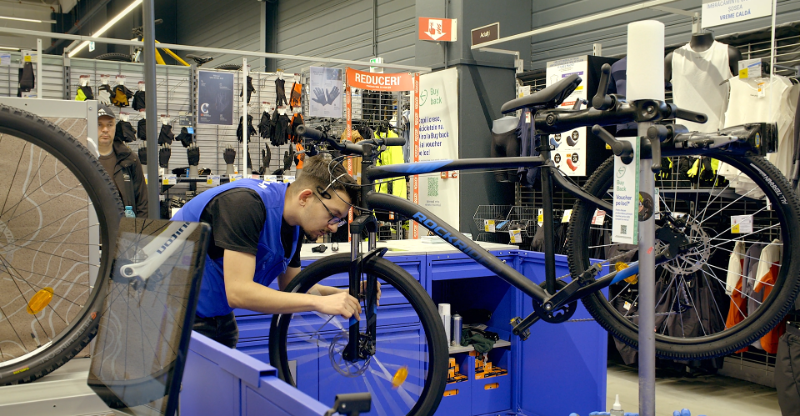
In Ștefăneștii de Jos, Ilfov county, operates one of Romania's largest repair shops, dedicated to sports equipment. In the last 12 months, over 60,000 products – from bicycles and fitness items to tents and kayaks – have been refurbished here.
The workshop serves over 30 service centers nationwide and is part of an integrated network of a well-known sports equipment retailer. Each time the company opens a new store, it also includes a service center. This functions either as an actual repair shop or through a buy-back system. Products brought in by customers are technically evaluated, and depending on their condition, they can be reintroduced into the commercial circuit.
According to data provided by the company, 80% of items taken back through the buy-back system in 2024 were repaired and resold. Prices were 15–50% lower than those of new products, and a two-year warranty was offered.
The bet on repairs has proven to be a winning one. 15% of bicycles sold last year were refurbished bicycles. And in the case of skis, the proportion was even higher: 60% were second-hand products, reintroduced for sale after technical inspection.
Sustainability vs. Profitability
Gabriela Barbu, Sustainability Director at Decathlon Romania, emphasizes that buy-back and repair initiatives are part of an economic model that simultaneously aims to reduce environmental impact and ensure financial viability.
"Sustainability and profitability must go hand in hand because otherwise, no retailer or business would launch initiatives from which it loses. But they are profitable or sustainable in terms of economic performance for companies, looking at them as a whole. That is, if we expect to launch a sustainable business and it should be profitable from the beginning, just by looking at and analyzing the sustainability segment, it should be the one that brings you profit, in my and the company's view, it is not necessarily the best way to start.
Everything is viewed holistically. These are services we offer to the customer, and for this reason, we look at how often the customer returns, what is the customer's lifetime when accessing the sustainability process. The customer comes to the store more often. They come 2.5 times more often than a customer who only buys standard products and does not repair them and does not reuse them.
So yes, it is a business that grows thanks to these anchors that we offer our customers,"
she explained.
Internal Challenges: Employee Mindset
The first challenge, profitability, was therefore overcome over time with the help of data. However, the challenge related to employee mindset remained. Employees suddenly had something extra to do, besides their daily tasks.
The solution? Circular economy indicators in the bonus system. Between 33% and 50% of employees' monthly bonuses in stores are now correlated with the performance of sustainable programs.
And this is how, by motivating employees, the repair program gained momentum and contributed, in fact, to a larger sustainability goal. For three years, the company has already managed to decouple its carbon footprint from business growth. This is what must happen with the entire economy by 2050, according to European climate laws.
Repairs and reuse of sports equipment directly contribute to this result, especially by extending product lifespan and reducing waste.
The video report on Decathlon's sustainability initiatives opens the second edition of the campaign "Second Life. Circular Economy Models," initiated by the Sustainable Solutions Association, with the support of Stratos, aiming to inspire the business environment to transition from a linear to a circular business model as quickly and easily as possible.
The other 9 video episodes can be viewed here.