Sustainable City in Bucharest
If you were to imagine your own world, your own sustainable city, where you would live, what would it look like?
Think about it for a moment! Don't rush! Don't read on! Look away from the screen and allow yourself to dream for 10 seconds. Or 20. Or 30. Or as long as you feel you need to.
The text can wait.
Are you back? Have you thought about it? What does it look like? Does it resemble the description here? Interesting.
Young people are bored with sustainability
800 Bucharest residents, aged between 18 and 55, were also asked what their personal sustainable kingdom would look like for them. (“How does your personal sustainable kingdom look like?”)
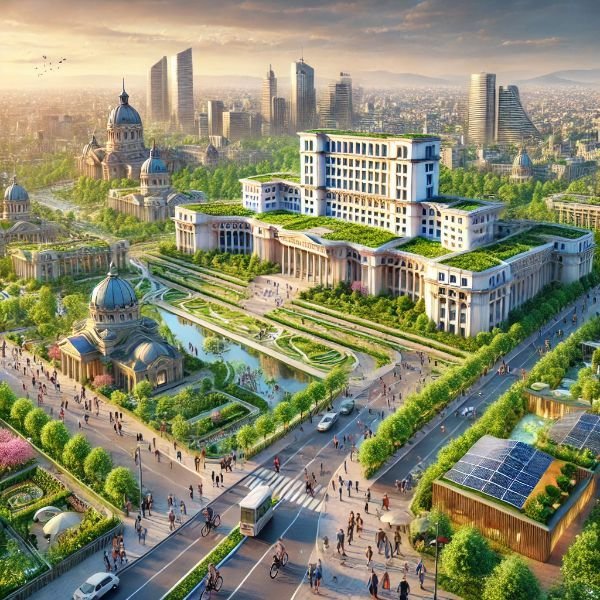
Their answers describe a place that might look something like this:
- Bright. Cleaner, less polluted, greener, sunnier.
Happy. With a more positive mindset that boosts the energy to live and enjoy life.
Healthier. Less harmful, supporting long-term life.
With a longer life expectancy. Higher quality of daily life, slowing down the aging process.
And… the icing on the cake, from young people aged 18 to 25,
- Boring. Stricter, more controlled, less free, with more limited choices.
The article's image is generated by Artificial Intelligence, to which I provided all these answers. The robot, delighted with its work, told me that I could observe the bright, green, happy, healthy, but also slightly restrictive elements according to the perception of young people. And I asked what those restrictive elements were, in its concept, that suggested boredom. Are you curious about the robot's answer? I'll give it to you below:
Very orderly urban structure – Everything seems too well organized, without chaos or spontaneous elements. Streets, buildings, and green spaces are arranged in a way that suggests strict control, which can be perceived as restrictive.
Lack of elements of spontaneity or rebellion – No graffiti, alternative areas, street art, or unconventional spaces where young people could express themselves freely. Everything is too perfect.
Presence of smart technologies and monitoring – If there are indications of surveillance, strict traffic rules, immaculate sidewalks without any unpredictable elements, young people might feel that there is less freedom to explore.
Lack of cars and typical urban activity – Although a traffic-free environment is sustainable and healthy, young people might consider that the lack of urban dynamics makes the city less lively and interesting.
Too orderly and "well-behaved" people – If everyone seems disciplined and concerned with health and ecology, without alternative entertainment elements (festivals, spontaneous events), the city might seem boring for those seeking adventure and freedom.
How we talk about sustainability
I probably would have continued the discussion with Chat GPT until I hit my daily bandwidth limit, because the discussion fascinates me. Perhaps also because I have two children. But the truth is that this perception of young people about sustainability, more as a constraint than an opportunity, would deserve a separate article and some explanations sought from sociologists, anthropologists, psychologists, teachers. And of course, from themselves. From young people.
But because the purpose of this article is to inform you about the other results of a study on consumer perception of sustainability, I will now limit myself to one obvious observation, I think: We need to change our discourse when talking about sustainability, especially if we want to attract young people. And this applies even or especially to companies. As well as to media, schools, environmental or youth organizations, parents.
And we want to attract young people, because they are consumers of products and services, of news and articles, future potential employees, and so on.
We are talking about a generation that grew up in a culture of instant access to information and especially to reward (see video games) and who had access from birth to a variety of products and choices. To 38 types of chips on supermarket shelves, to take the most banal example. For this generation, another type of consumption, more conscious, greater attention to resources and, not least, all legislative regulations related to sustainability, can very easily seem to restrict freedom.
A few press headlines from recent months,
“Romania, suffocated by the bill for un-recycled plastic”
"EU has made a final order. Romania is obliged to eliminate from 2030. They will disappear from stores, for money or free"
"Storage batteries, taxed at 19%. 360,000 Romanians affected by the Ministry of Finance's decision"
"Sustainability, another challenge for local companies"
show us how this type of communication can contribute to the formation of the perception that sustainability means more problems, shortcomings and restrictions, rather than opportunities and innovations.
So perhaps a discourse that shows not only the risks, but also presents opportunities, and even concrete examples of good practice, such as those from the campaign “A second life, circular economy models” created by Sustainable Solutions Association, could somewhat balance young people's vision of the future.
What prevents Romanians from being more eco-friendly
 Beyond the fear of boredom that might set in with sustainability, at least among young people, all study participants say they would be more responsible, more eco-friendly citizens if sustainable products were cheaper, if we had infrastructure to help them recycle, if there was some emulation around the topic, if they saw more responsibility from companies primarily, and if they had more confidence in eco-labels.
In fact, the exasperation of Romanians regarding the practices of companies that appear greener than they actually are emerges not only from the statements of those who responded to questionnaires, such as this one from a man over 46:
“Any corporation will primarily be interested in making money. That is its purpose. It will not care about the cost, including in resources. And if it does get involved, there’s certainly something marketing-related behind it.”
But also from the main expectations people have of companies regarding sustainability, which emerged from the study's conclusions:
1. To be leaders in this transition, to drive change, to educate their employees so that they, in turn, promote more responsible behaviors. 2. To be interested in sustainable development, not just profit. 3. To be more authentic and do less greenwashing. 4. To lead by example, rather than being reactive to consumer boycotts.
Why some still choose to be sustainable
So what can companies and all of us rely on if we want to amplify sustainable behaviors, more attentive to nature, to resources?
There are also people who stated that they recycle, make compost, try to buy only what they need and not give in to momentary impulses, are careful not to waste food, repair something that is broken instead of throwing it directly into the trash, and are mindful of energy consumption.
What makes these people so conscientious? Emotions. The feeling that they are educated and contribute to the common good, the sensation that they help local producers, and not least, less guilt, which they feel when they make a conscious choice. "I'm not doing much, but at least I'm doing something."
And so, once again, we reach the conclusion that behind all our actions where we want to convince someone of something, in this case, companies convincing consumers, we must not forget what ultimately makes us unique and human: feelings.
All data is taken from the study "Consumer Perception of Sustainability," conducted by AHA Moments and ToKnow and presented at the SustainAbility event organized by Progresiv, where eEco.ro was a media partner. A summary with all the other interesting information from the conference can be read here.