Photo Gallery
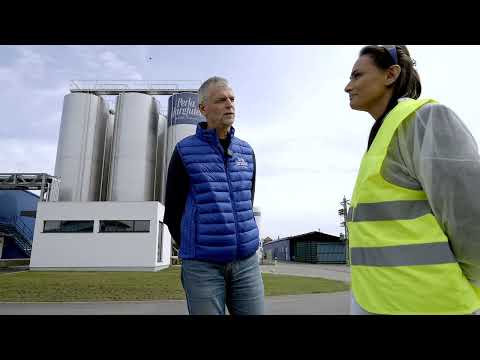
In Sâncrăieni, Harghita County, a factory has been bottling mineral water since 1974. For over 50 years, it has used reusable, returnable glass bottles for home consumption and, more recently, for the HoReCa sector.
At Perla Harghitei, 15 million bottles a year are used in a closed-loop system, primarily regionally, in neighboring counties. What does this mean? The bottles released onto the market are returned to the factory, washed, and reused 30-35 times.
The factory also bottles water in PET, but the company does not want to give up glass bottles, which account for 25% of the business. Mihai Neagu, the company's CEO, says that the main reason they don't want to abandon glass is related to the company's structure. It's a family business, now in its second generation, built on the idea of tradition.
"We preferred to maintain this business line not for economic reasons, because it's quite a difficult business and much less profitable than the PET business, but it's a business we identify with. And in which we continue to invest. This has ultimately led us to have over 50% of the bottled mineral water market in glass bottles. We are quite determined about this business, and we continue to develop it in two directions," says Mihai Neagu.
The first direction of development is technological. The company invested 5.4 million euros in a water management station, which saves 5 million liters of water from waste per year. This is mainly due to the six tanks, each with a capacity of 150 cubic meters. Istvan Szabo, the operational director, explains how waste is avoided: "So we have a storage capacity of 900 cubic meters of water where we store mineral water already prepared for bottling. Their role is to allow us to operate our water sources continuously and at an optimal flow rate. In case of any stoppage – if, for example, for one reason or another, when we don't have an order or the warehouse is full – then we have to stop our process of bottling, of preparing the water for bottling. This means a waste of water, practically, because all the water we have in our pipeline from the sources, we would practically lose. Because every time you stop, that water has to be aerated in the pipe, it will have other characteristics – so for food safety – we empty the pipe every time we start production."
The second direction of development is new distribution channels. In the HoReCa sector, with returnable glass bottles. This means restaurants send empty bottles back to the factory in crates, just as they arrived, instead of sending them for recycling. A similar system is also being developed for individual customers.
Mineral water from the springs in Harghita is delivered directly to homes, in returnable glass bottles. This is a newer project of the company, but so far, it is promising, as the number of customers doubles year by year.
Here's how a seemingly less profitable gamble on the circular economy turns out to be a winning one after all.
You can see the full story of how a Romanian company became more competitive through circular economy initiatives in the video report. Episode 11 of the campaign "A Second Life. Circular Economy Models", initiated by the Sustainable Solutions Association and financially supported by the environmental consulting company Stratos, with the aim of helping the business environment transition from a linear to a circular business model, faster and easier.
The other 10 episodes can be viewed here.