Photo Gallery
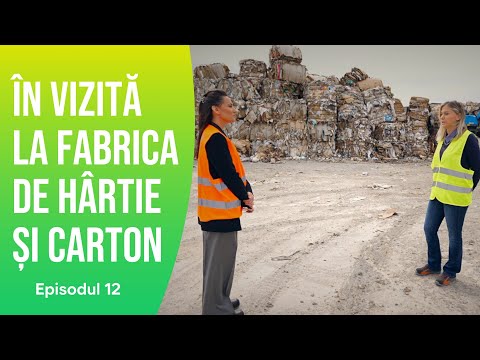
In Suceava, the former Paper and Pulp Mill, opened in 1962, was privatized in the 90s and became the company Ambro, part of the French group Rossman. It continues to produce the most manufactured type of paper worldwide: paper used for corrugated cardboard, which in turn is one of the most used packaging materials in the world.
The paper is made 100% from recycled paper. This makes the production process more difficult because recycled fiber loses some of its strength characteristics through recycling.
Every day, 550 tons of recycled paper are processed to obtain 500 tons of recycled paper.
The factory only started using cardboard waste for paper production in 2007. Until then, paper was made from wood. This change came out of necessity, as explained by Roxana Chiș, ESG manager at Ambro:
"At that time, some furniture investors entered the market and exploited forests. (2:05) If the raw material consisted of wood waste, they would take everything and in turn not sell us the fiber needed for pulp. (2:20) So we found ourselves at risk of closing down and had to quickly reorient. At that moment, it came out of a need, and we can say that's how the circular economy thread began."
Lacking raw material, the company was therefore forced to completely change its business model. It invested 15 million euros in new equipment to be able to produce paper from cardboard waste instead of wood waste. The transition from linear to circular not only helped them survive in the market but also proved to be profitable.
Mihai Banu, Ambro technical advisor:
"Basically, compared to the period when pulp was produced, electricity consumption has dropped to about 50% of what it used to be. And the steam consumption previously used for paper and pulp production was 3-4 times higher than it is now. Fresh water consumption for pulp and paper production was 4-5 times higher."
Seeing the advantages of the circular economy, the company continued to invest in such measures. It installed a cogeneration plant that cost 9 million euros, an installation that led to a reduction in electricity costs, a decrease in the carbon footprint, and energy independence.
Circularity then extended further, to the company's other factory on the same industrial site, the corrugated cardboard factory. This factory now operates in perfect symbiosis with the paper factory. Paper is sent to the cardboard factory as raw material, and waste from the cardboard factory is sent back to the paper factory and becomes pulp for new recycled paper.
How the transition from a linear to a circular business model proved to be a real business asset can be found in episode 12 of the campaign "A Second Life. Circular Economy Models", produced by the Sustainable Solutions Association with the help of the environmental consulting company Stratos. A project initiated with the aim of accelerating Romania's green transition by providing examples of good practice from the business environment.
The other 11 episodes can be found here.