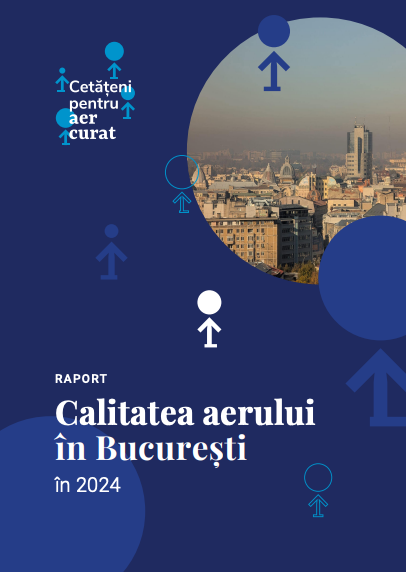
Air Quality Report for Bucharest 2024
Main conclusions of the report
- In Bucharest, in 2024, PM2.5 levels frequently exceeded legal limits at several stations, especially during the cold season when pollution increased by up to 200%.
PM10 shows exceedances in heavily trafficked areas such as Mihai Bravu-Dristor and Giulești Sârbi.
PM2.5 and PM10 pollution exceeds the thresholds imposed by Law 104/2011 and the related European directive, which will lead to a new infringement procedure for Romania.
Although there are no systematic exceedances of legal limits, there are periods and areas where NO2 levels are close to the maximum permissible threshold.
Massive involvement of citizens from two Bucharest communities
For the first time, the Report included analyses based on citizen air quality monitoring tools, carried out by Ecopolis and the Parinti de Ciresari association, as part of a civic project entitled Citizens for Clean Air. Thus, citizens from two communities were actively involved in monitoring campaigns, highlighting issues related to indoor pollution in schools, the impact of residential heating, and pollution on school routes. These are their main findings:
- The data obtained confirm a clear link between increased pollution and low temperatures, heavy traffic, and insufficient ventilation in classrooms.
Students in schools are exposed to high levels of carbon dioxide - CO2, frequently exceeding the threshold of 1000 ppm and reaching as high as 3500 ppm, which affects concentration and general health.
On days with heavy traffic, PM10 and PM2.5 levels frequently exceed limits on students' routes to school, including in public transport, exposing them to respiratory risks.
The traffic study in the Grivitei Domenii area showed that heavy traffic, the lack of well-placed pedestrian crossings, and excessive speed contribute to air pollution and reduce pedestrian safety.
The tools created for the communities and the actions of the citizens can be consulted on a new online platform, dedicated to the Citizens for Clean Air program.
The full analysis report, which contains all conclusions, graphs, and methodologies, can be consulted HERE.