Deposit-Return System Symbol
On November 30, 2023, Romania's largest strategic circular economy project, the Deposit-Return System (SGR), comes into effect. This system will allow us to return PET bottles, glass bottles, and aluminum cans to stores for recycling, and in exchange, we will receive 50 bani back.
We won't gain anything extra from this; we will merely recover the money spent on beverages, which will also become 50 bani more expensive.
To receive the deposit back, we must consider three aspects:
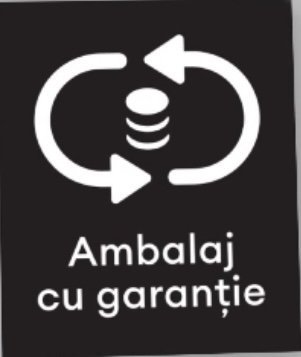
- The "Deposit Packaging" symbol (see photo on the right, black background) must be present on the label.
The packaging must be emptied of its contents.
PET bottles and aluminum cans must not be flattened.
What packaging is not included in the system
The Deposit-Return System has already been implemented in ten European countries, but on a smaller scale. In Romania, it is the second largest in terms of scope, after Germany, considering the seven billion packages expected to enter the system.
It applies only to beverage packaging, whether it's still or sparkling water, juices, beer, or wine.
Unfortunately, the system does not include milk or yogurt bottles, tomato juice bottles, jars of any kind, or cardboard or Tetra-Pack cartons. These will have to be disposed of separately, as before, at home, to be collected by local authorities or their contracted companies. This applies where the system functions. Where it does not, people will continue to try to manage as best they can.
Invited to the PRO VERDE show on stirileprotv.ro, Raul Pop, program director at ECOTECA, co-founder and vice-president of the Coalition for Circular Economy, commented on this situation:
"For now, we are talking about a limited set of products, which are beverages. From one point of view, this makes things simpler; from another, it makes them more complicated.
They are simpler because the number of companies involved in financing this system are only those that sell beverages, probably around 1500-2000 companies. If we were to extend it to toothpaste, dairy products, oil, vinegar, rubbing alcohol, detergent, cardboard milk cartons, automatically, another 500-600 companies would be added to the existing 500. From a certain point of view, this might seem more complicated. But in my opinion, it would be simpler because then we would know that we could take more items to this Deposit-Return System. And the financing of its operation, which obviously costs money, would be distributed among more people."
Under these conditions, where we can only return beverage packaging to stores, and not other types, it is hard to believe that the system will achieve its main goal of helping Romania meet the collection and recycling targets it has committed to at the European level, namely:
77% for PETs - by 2025
75% for glass - by 2030
60% for aluminum - by 2030
Raul Pop: "This system refers only to beverage packaging. I also have plastic bottles for shampoo. I won't meet this target there if I don't have a deposit system, because I have to meet my target through the collection system we know works — or rather, doesn't really work now — separate collection from households through the city hall's systems, along with the sanitation company. However, for now, our performance there is very low, around 40%.
After beverage packaging, which goes through the Deposit-Return System, disappears from this 40% flow, this will drop to 30%, maybe 20%. And we need to reach 70%. The discrepancy is still very large. And that will be a very big challenge.
The simple and readily available solution is that once you have a Deposit-Return System, you put as much material into it as possible.
The more complicated solution, which we have been pushing for at least 15 years, with the timid results we see, is quality household collection. And there, we still have big steps to take."
The full interview, in which we also discussed the system's implications for the 80,000 retailers who must compulsorily register for implementation, as well as other interesting information about recycling, can be watched in the video.