In 1864, Gerard Heineken was a young and ambitious entrepreneur with an artistically trimmed beard and mustache. Moreover, he owned a microbrewery. But it wasn't cool. The problem was that Gerard started by producing a range of strong beers, mostly top-fermented: Ale, Porter, and Old Bruin. However, all the 19th-century hipsters preferred something else: Bavarian lager.
Thus, Gerard decided to take a big risk: he invested all his money in two new breweries that produced only lager. A major decision!
A century and a half later, the small factory in Amsterdam became one of the largest beer producers in the world, with 167 production units in over 70 countries.
Three of the factories are in Romania, where 14 of the 300 beer and cider brands from the group's portfolio are produced. The largest quantity of beer is made in Craiova, 190 million liters per year.
The malt used for the beer is mostly purchased from Romania. The origin of the ingredients is important for the company because carbon footprint measurements have revealed that 21% of carbon dioxide emissions come from agriculture. The group's main goal is to reduce CO2 emissions as much as possible.
Reduction
The main ingredient in beer production is water. For each liter of beer, 3.5 liters of water are used.
The factory in Craiova has managed to reduce the amount of water used in the production process by 50% over the past six years.
25% of the water amount was reduced without major investments in equipment, just by optimizing processes and eliminating losses. Another 25% of the water amount was reduced with the help of modern technology and equipment. For example, an additional system for filtering the bottle washing solution installed in October 2025 is already showing significant results.
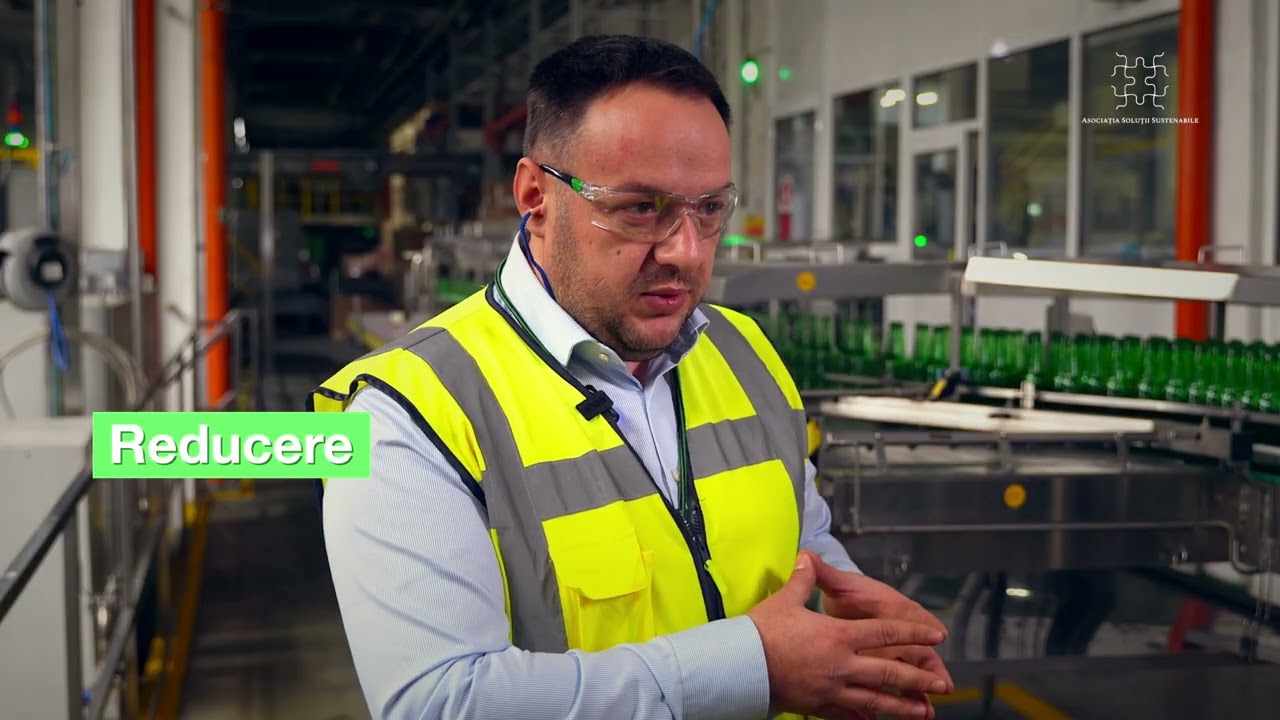
Adrian Niță, Packaging manager HEINEKEN:
"In the past, we regenerated the solutions used for washing bottles once a week, but now we can go up to 4 weeks without regenerating the solutions (50:23), of course, by monitoring daily and weekly process parameters that are relevant to ensure that the bottle hygiene is appropriate and safe for consumption.
It reduces the amount of water, thermal energy, and soda used."
Reuse
Bottles are washed because 20% of the beer produced in Craiova is placed in returnable and reusable packaging. 50 million bottles are thus reused annually, especially those that go to HORECA.
31% of the company's carbon footprint comes from beer packaging. To reduce emissions produced by packaging, reusing bottles proves to be more efficient than returning them to the RETURO system, in stores.
Adrian Niță, Packaging manager HEINEKEN
Certainly, the bottle we take to the deposit-return system is not reused. It goes through a process where it is destroyed, brought back to some extent to raw material, and re-enters the production cycle from scratch.
If a bottle were used only once, it would have to be produced the next day and the day after that, and so on. Being reusable, we produce it once and use it for up to 10 years or even more.
This is without considering the waste generated by using non-returnable packaging.
Recovery
A lot of water is used in beer production not only in the composition of the drink, but also in the process of cooling the beer wort and in generating steam for boiling.
The factory has managed to reduce the steam used and sometimes even eliminate it from processes.
Ion Gore, Brewing manager HEINEKEN Romania:
In the energy recovery unit, on one side of the plate, the hot wort circulates out of the wort exchanger, while on the other side, we have sub-cooled water that absorbs heat from the wort and brings it back into the process. Thus, the heat obtained from the previous batch will be used almost 98% in the next batch when the hot water meets the mash.
This practice is quite common in the beer industry, but what did we do? We increased the capacity of the heat exchanger, and through two-stage cooling, we managed to increase energy recovery by 15% during the wort cooling process. This allows us to consume much less steam when we produce this part of the wort. And what does steam mean? Steam means burnt gas used in exchangers to generate that steam.
One of the largest projects implemented in the Craiova factory refers to using heated water for beer pasteurization instead of steam. This is possible thanks to heat pumps. They recover heat from the cooling plant, heat the water, and the heated water is used in the pasteurization process.
In parallel with reducing water consumption, another important objective for the company was reducing energy consumption. The heat pumps installed at the end of last year, which cost 12 million euros, should bring a 40% reduction in energy consumption.
Georgiana Ciurba, sustainability manager at HEINEKEN Romania, believes that the Craiova factory has achieved such good results in reducing consumption because it had the freedom to decide the best solutions on-site, without necessarily having to implement measures transmitted from the center.
"Our colleagues are encouraged to find improvement solutions based on their work and the technology they use. We don't necessarily impose using a particular solution because it might not be the most efficient in that context," she says.
By applying reuse principles, the producer sends only 0.5% of waste to the landfill.
The main waste of a brewery is spent grain, what remains after cereal distillation.
In Craiova, 150 tons of spent grain remain daily. Which is sold as animal feed.
Not only are leftovers valued, but also surplus.
Ion Gore, Brewing manager HEINEKEN Romania:
The disadvantageous part for us is that during the beer production process, brewer's yeast is produced in excess. So, to not waste this excess, we need to valorize it in a certain way. How do we do this? First, the brewer's yeast undergoes a thermolysis process, and then it is transported to animal breeding units, serving as an essential factor in their nutritional diversification, being a very important source of proteins, microelements, and B-group vitamins.
Through such measures, the beer producer managed in 2025 to reduce its global carbon footprint by 19% compared to 2022. The group's goal is to become NET ZERO by 2040.
NET ZERO is a target assumed by many large companies and involves greenhouse gas emissions being equal to those eliminated.
The corporations' goal responds to the EU's target of achieving climate neutrality by 2050, to contribute to reducing global warming.
The video report filmed at the Craiova factory is episode number 16 of the campaign "A Second Life. Circular Economy Models", produced by Asociația Soluții Sustenabile with the support of the environmental consultancy company Stratos. A project initiated to accelerate Romania's green transition by providing good practice examples from the business environment.
You can see the other 15 episodes here.