Sustainable Tourism in Vietnam
The most sustainable tourism is the one you don't do. It's when you stay at home. Just kidding, of course. But only half-joking.
The half-joke is that, in reality, it's important to travel. For us as individuals, there are a lot of benefits to travel, which we notice with our own eyes every time we go away or which have been proven over time by all sorts of studies. Travel helps us cope better with the disease of the century, stress, it helps us be more creative, more productive at work, and even healthier.
And for the visited country and its inhabitants, tourism is a godsend. Or it should be. It contributes to economic growth, business development, supporting local entrepreneurs, and job creation.
In 2020, for example, there was great distress in Europe due to losses caused by travel restrictions during the pandemic. The EU lost two million jobs in the travel and tourism sector, and its contribution to the Gross Domestic Product was halved compared to 2019, from approximately 10% to 5% of GDP.
The half-serious part is that tourism has grown at such an accelerated and barbaric pace that it is starting to pose serious problems. 8% of greenhouse gases, those that cause climate change, come from the tourism industry. Because this industry actually brings together several polluting industries: transport, construction, goods and services, accommodation, food and drink, agriculture.
We leave home, but we try to be as responsible as possible
Since travel contributes the most to carbon emissions, it would probably be ideal to go as close to home as possible.
Avoid flying.
Try to go to less touristy areas, because that's usually where the most pollution, waste, and disturbance occur. See Barcelona, where all the fences say "Go home, tourists."
Maybe go during the off-season, when it's also less crowded.
Stay in hotels and guesthouses that make efforts to avoid energy and food waste, source locally, and try to be more responsible themselves.
And once you arrive at your destination, consume as many local, organic products as possible, directly from the source, and try to help the local community through your visit there.
This, in a nutshell, is what sustainable tourism means. You can find out more about it in this interview: Tourism in the Climate Change Era.
Vietnam
In our case, the visit to Vietnam obviously doesn't tick the box for being a short distance from home. And therefore, not the part about avoiding planes either.
We chose knowingly. I know that the aviation industry has a carbon footprint of 2.5% of global emissions. And I know that, although it seems small, it's only small due to social inequality. Very few people can actually afford to fly.
So I know we are among the privileged. And there are times when I feel guilty about such privileges. And others, when I am grateful. For this long flight, the only one this year, I choose gratitude for everything this trip has offered me, instead of blame. Maybe we'll give up traveling far at some point. Maybe we'll be forced to. For now, however, we are here. We choose to travel far, if we can, once a year.
But, what we try to do, if we're going to travel far by plane anyway, is to consider the other aspects that make a trip more eco-conscious.
This vacation in Vietnam ticks almost all the other boxes related to sustainable tourism, apart from the journey there. Intentionally or even by chance, sometimes. And considering that it was a long vacation, a month long, unlike any we've had before, where we moved around a lot and stayed in many places, I hope it compensates, at least somewhat, for the large carbon footprint we had because of the round-trip flight.
Less touristy destination. For now
Although tourism has grown enormously in Vietnam in recent years – from 2 million foreign visitors in 2000 to 18 million in 2019, the destination is still relatively unknown as a tourist spot, at least to us. However, I believe that in the coming years, Vietnam has every chance of becoming the next Bali, Maldives, Thailand, Seychelles, or any other exotic destination. Because it's cheaper and at least as beautiful.
They still have work to do on cleanliness, services, and speaking an international language, but the natural and wild areas are wild everywhere. And fascinating. And the beauty of nature often outweighs the quality of services or the fact that no one speaks English. I think so.
Off-season
In Vietnam, you can travel from February to June in certain areas. And from October to March in other areas. So, in July-August, when we went, it's not really advisable to go. Because it's too hot in the center. Or rainy season in the north and south. Rainy practically means it rains every day.
But we took the risk and went. With two children in tow. Deliberately. We knew about all this. I don't want to go into too many details about why we made this decision, but somehow I also hoped it wouldn't be that bad. And we were actually lucky. It wasn't bad. In fact, we liked it. We learned to adapt to tourism in the rain or to always be prepared for rain, with our ponchos. And this took us out of our comfort zone and gave us an adventurous spirit that we even started to enjoy at some point. But the truth is also that it rained mostly at night and in the morning. After 11:00 AM, we didn't experience much rain. Maybe only in the mountains. But always warm and welcome, given the heat.
Then, once we arrived, we paid attention to where we stayed, how we traveled within the country, what we ate, what we drank, what we bought, what we visited.
Let's take them one by one.
Transportation
Vietnam is a long country. Much like Italy. Both in terms of area, around 300,000 square kilometers, and in its vertical positioning. From north to south, the country spans 1,650 km. Italy is 1,185 km long. And by comparison, Romania is 530 kilometers from top to bottom.
So the distances are great, and because of this, people travel a lot by plane within the country.
However, feeling a bit guilty about our already long flight there, and also to save money and, why not, experience new and potentially fun things for the kids and for the inner kids in us, we chose to cover the long distances by night train and "sleeper bus," instead of flying.
And it was brilliant. The children had fun, and we were relaxed.
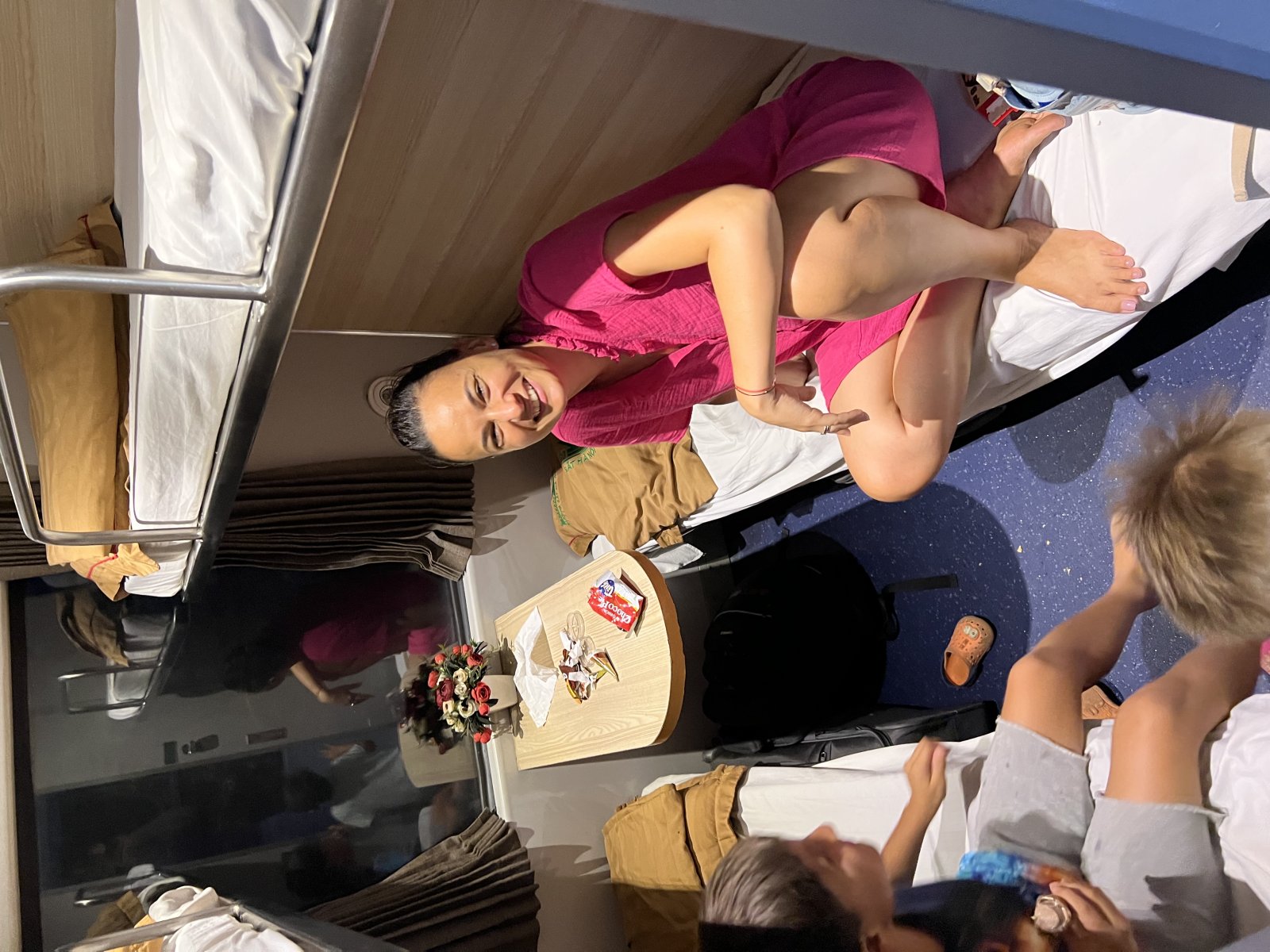
We moved several times in one month. From south to center, from center to north, and from north back to south. And we managed, with only one exception when we had no alternative, to avoid flying. I felt this was the greatest achievement in terms of eco-tourism.
The longest distance, about ten hours, to the capital Hanoi, we traveled in a four-berth sleeper compartment, where we enjoyed privacy and slept better than I expected. And other more reasonable distances, 4-7 hours, we did by sleeper bus, which I heard about for the first time, where there are no seats, but only some reclining chairs (in some models) and actual beds (in other models). Super comfortable. Especially the ones with beds.
These buses seemed like a great invention to me, and I wondered if they wouldn't work in our country too. Considering that our railway infrastructure isn't working out. I think it would help boost domestic tourism. I know many people from Bucharest who don't go more than three hours away from home because they don't want to drive that far. But traveling to Cluj or Hunedoara with such a bus would seem very helpful.
Not to mention trips to Greece, Bulgaria. Instead of spending 8-10 hours on the road, by car, arriving exhausted, you can read, sleep, play games, and arrive fresh at your destination.
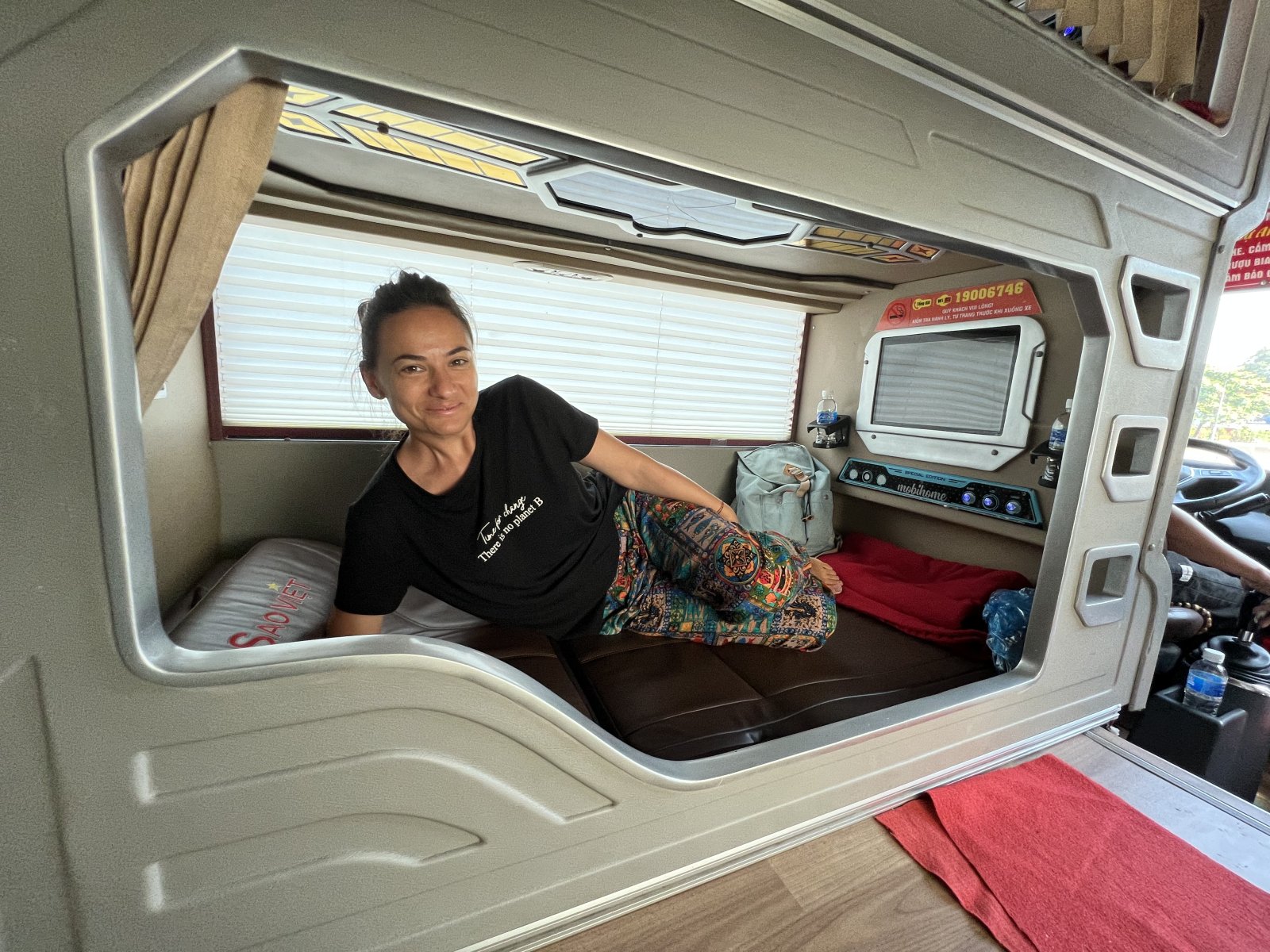
As a colorful detail, there, in Vietnam, you are asked to take off your shoes when entering the bus. Mostly through pantomime, but you get the idea. You are given a bag to put your shoes in, and you can only put them back on when leaving. If there's a stop for a pee break, some even offer slippers, just enough to get off the bus and come back.
It's also worth noting here that Vietnam is the land of sandals. Like probably most tropical countries. People don't really wear anything else on their feet. Perhaps that's why it's easy for everyone to ask you, everywhere, to leave your shoes at the entrance. Or maybe it's simply a cultural thing, I don't know. The fact is that in museums, temples, even in the toilet, in a public restroom by the sea, we were asked to take off our shoes. I found it very interesting.
I was saying that there were also accidental sustainable things that we enjoyed and took as they came. Like, for example, the fact that in cities we mostly traveled by electric taxi. Because most taxi companies had Vinfast cars, their national brand, and I think this company only makes electric cars. Or the fact that on an island we only rode electric buggies, for the simple reason that there were no cars there.
Accommodation
We had seven accommodations in one month. In the city center, on the outskirts, in the countryside, by the sea, on a mountain top, on an island. And we stayed in apartments, boutique hotels, guesthouses, with families. But every time we chose accommodation, an important criterion was for it to be as sustainable as possible. How did we do this?
We searched for all accommodation on Booking. And one of the criteria we always ticked was "travel sustainable". In this way, we could only see those accommodations that make efforts to have the smallest possible carbon footprint, on a scale of one to three. Level one makes fewer efforts. Level three makes the greatest efforts.
How accurate and transparent these filters are, how you, as a simple citizen, can verify everything the owners declare before arriving at your destination, is another discussion. But at least we tried to do this initial screening.
Booking explains how it awards these sustainability badges and also provides some case studies, from which we deduce that there are 32 sustainability practices that owners can tick. From methods to reduce water consumption, prevent food waste, recycle, educate, green spaces within the property, 80% LED bulbs, to helping the local community through tours or activities offered by locals. And, very importantly, the promise that they do not offer single-use plastic products, such as cups, cutlery, water or juice bottles, small shampoo or shower gel containers.
Looking at their website, where they describe the program, I couldn't help but notice the phrase "We are currently developing a verification process that will help us ensure that the sustainability information we provide to guests is as accurate and up-to-date as possible. It combines two processes: feedback from previous guests of a property and collection of evidence from a trusted third-party auditor." Which, as I understand it, means that for now they rely on trust in granting the badges. No one goes to the site to actually check the declared statements. Yet.
But the truth is that at all seven accommodations, most of the promises ticked seemed to be kept. We didn't really get plastic bottled water. Some had water in glass carafes or bottles, others didn't offer any water at all. And others, who gave us plastic bottles, also told us that tap water could be drunk if we boiled it, and we also received a kettle for boiling. Which we appreciated.

Otherwise, everywhere, shampoo and shower gel were placed in reusable containers, food was always predominantly made from local products, I also noticed the LED bulbs in the rooms, and I certainly noticed this close collaboration with the local community, because always, at the slightest request, the hosts would quickly make a phone call and send us a local to offer some service: transportation, massage, guided tours, anything.
However, I found it strange that absolutely everyone offered toothbrushes and mini toothpastes. Made of plastic. Non-recyclable, as we know. Which I consider to be single-use plastic products. I would say it's an oversight by Booking. The fact that they don't include plastic toothbrushes and especially mini toothpastes in the items that should not be offered if you want to be considered a sustainable hotel.
Eco Lodge, Farmstay and Homestay
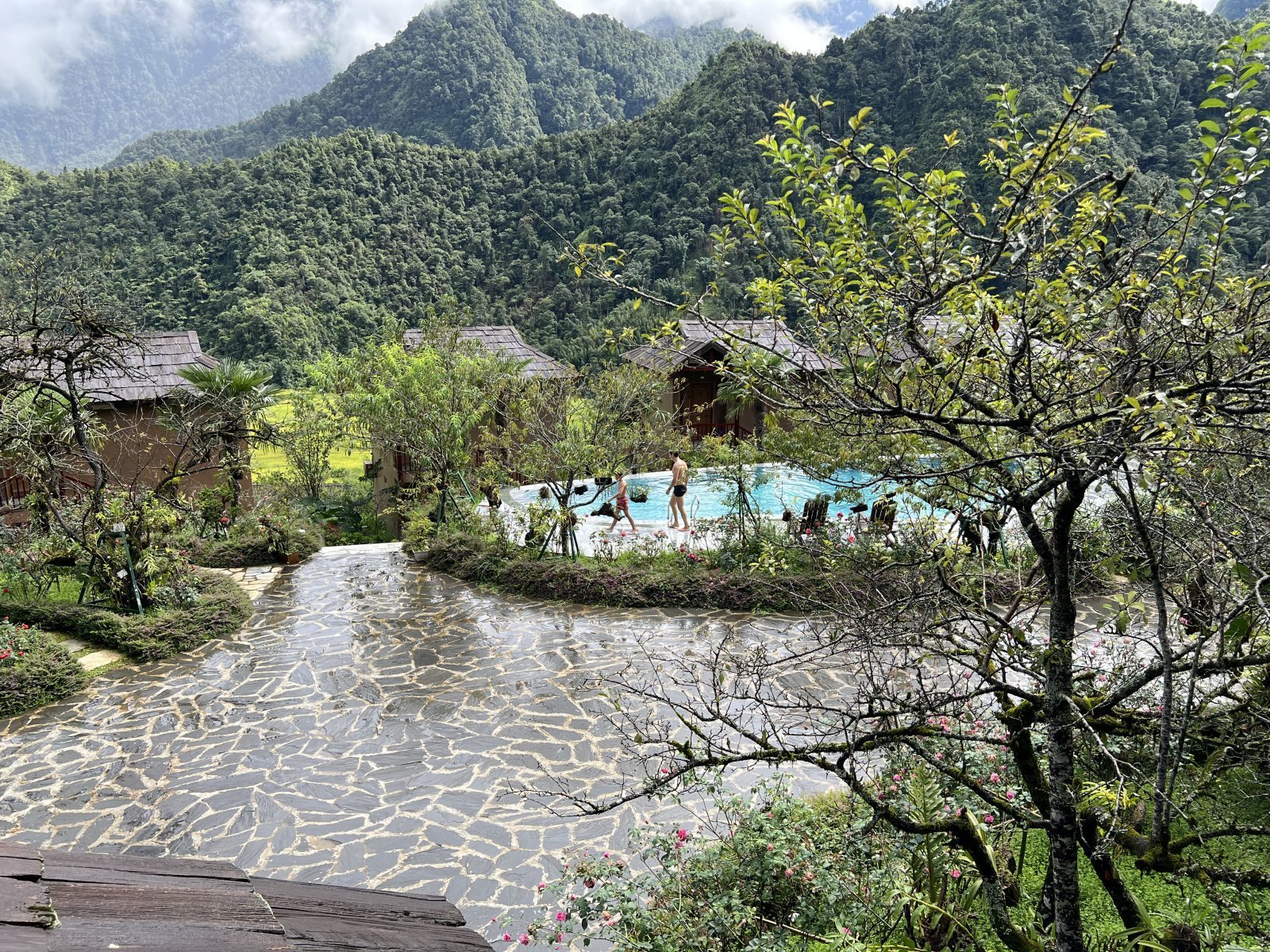
Three of our accommodations were in so-called Eco Lodges, one of which was also a Homestay. And we spent a good part of the day at a Farmstay, although we didn't stay overnight. All these names I encountered very often in Vietnam, and they all seem to me to be sustainable accommodations.
I'll take them one by one.
Although there are all sorts of definitions for an Eco Lodge, what I understood it to mean, in short, beyond all the other criteria that make accommodation sustainable and which I exemplified above, is the location. Usually, in the midst of nature. Far from cities, hustle, and bustle. In a natural setting where the construction industry has less impact. That is, not large hotels, large resorts. Something small, intimate, a few rooms.
And even if there isn't an international or even local certification for this - it's enough to self-proclaim yourself an Eco Lodge - these criteria were actually respected. One Eco Lodge accommodation was in a village. One on a mountain top. And a third on an island.
In one case, the hosts stayed there with us, in the same yard. They had built some rooms that they rented out. And that's what they lived off. This was also the Eco Lodge Homestay property.
And at the Farmstay, some agricultural activity also happens. They either raise animals or have gardens with all sorts of vegetables and greens. And tourists can participate in such activities.
Why is it sustainable to stay in such places?
Firstly, because you help the local community. These properties usually do not belong to large hotel chains; they are owned by locals. Then, you eat local fruits and vegetables, probably organically produced most of the time. You learn about the local customs, you have an authentic experience. And you contribute, through your money, to the development of that community. Plus, the price is often lower than at regular hotels.
However, the disadvantage can be that sometimes the experience is "too" authentic. Perhaps more than you can handle. Not speaking a foreign language can mean getting something other than what you ordered for food. Or the food might be too peppery, even though you thought you specified "not spicy," "not hot," "not chilly." Or there might be a menu only in the local language, which you don't understand at all, in our case Vietnamese. And thus, 50 minutes might be spent just on placing an order.
Google Translate helped us enormously. But it also has its limitations.
In conclusion, however, we did not regret the "too" authentic experience. And we would not trade the Eco Lodge experience for a classic hotel one. We have hotels everywhere. An Eco Lodge is rarer. And certainly more interesting to experience, primarily for a greater connection with nature.
Food and drink

I don't know about you, but for me, an important part of the tourist experience is also the food. Tasting local dishes. Well, interest in local cuisine is welcome not only for an authentic experience but also because it can directly contribute to reducing the carbon footprint of tourism. Food production has multiple implications for sustainability, from biodiversity and ecosystem loss, land conversion, water consumption, pesticide use, to genetically modified organisms, animal welfare, or the modification of global chemical processes, such as the nitrogen cycle.
With more thought perhaps to exciting my taste buds than to the nitrogen cycle in nature, I ate noodles and fried rice for a month until I was sick of them. But at the same time, I also transcended the immediate and permanent need for gustatory pleasure and ate:
soup for breakfast, although I wasn't used to it, coconut water directly from the nut instead of bottled, imported juices, even though I'm not a big fan of coconut, a kind of Chinese grass, quite tough, fibrous, and bland for my taste, but which was green, local, and therefore probably nutritious.
I tried almost all their specific foods and drinks. Without intending to be martyrs, but also without insisting on looking for our usual products, just to avoid stepping out of our comfort zone. How could I go to the supermarket to look for plums, apples, and pears imported from who knows where, when dragon fruit, guava, mango, and pineapple were in abundance?
With such a balanced approach, I believe, I discovered a coffee specialty that blew me away: egg coffee. And I ate the most delicious food, from some stalls that probably would never get approval from the Public Health Directorate in Romania.
Shopping
After transport and food, shopping is also a major generator of greenhouse gases in the calculation of tourism's total carbon footprint. Souvenirs, magnets, hats, figurines, clothes, and accessories – all of these seem to be part of the tourist experience. But we need to be careful about what and how much we buy if we want to be responsible tourists.
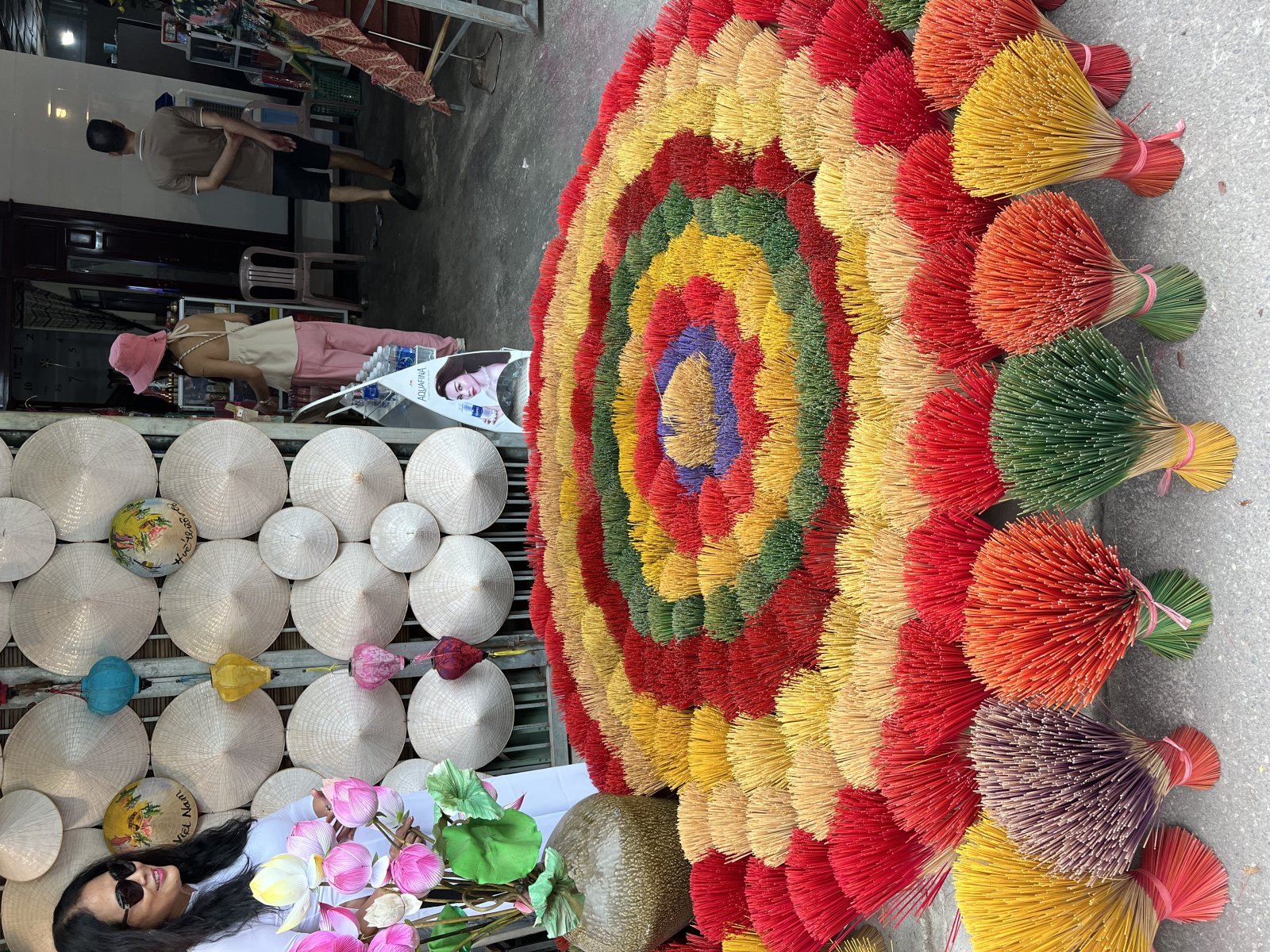
We tried to primarily consider the principle of "Reduce consumption," generally valid both at home and when traveling. Not to buy something just to buy it, just as a fun activity. This is what we always try to convey to our children. Do you need it? Do you really like it? Is the size right for you? Is the material natural? Do you absolutely want a souvenir? Perfect! But let it be one, not 100. Do you absolutely want a toy? Okay, but let it be one, not 10.
Then, the main criterion we applied, if we had already moved past the questions above, was for it to be a locally produced item. Not imported. That's how we brought home, for ourselves, friends, and family:
Vietnamese coffee from small producers - we learned that Vietnam is the second-largest coffee producer in the world. Lotus and jasmine tea. Clothes made from certified organic cotton, produced by local designers, from shops that also provided receipts - because there are many stalls with fakes. Souvenirs made from eggshells by people with disabilities - there's a big discussion there about the effects of dioxin, a toxic substance that Americans dispersed during the Vietnam War (1962-1971), on the children of that time, now adults.
Beyond the larger carbon footprint of products brought from overseas, there is also the phenomenon of "economic leakage," a significant challenge for popular destinations. This phenomenon occurs when hotels, restaurants, and shops import goods, and thus the money generated by tourism, instead of helping the local economy, goes to large international companies.
And we don't want that. What we want when we aim for sustainable tourism is to support the local community, however we can. If we keep only this single aspect in mind, then inevitably all our choices will be inherently more eco-friendly, without us having to make special efforts.